

What Is Engineered Quartz Stone and How Is It Made?
Engineered quartz stone is a manufactured surface made by binding crushed natural quartz with resin and pigments into a hard, solid slab. Granite and marble are quarried and cut. Engineered quartz is produced in a factory, so colour and pattern stay consistent from one slab to the next. This is why it is so common in kitchen countertops, bathroom vanities and commercial counters.
If you are searching for this material, you probably have a specific worry: Is it natural? Will it stain? Can I put a hot pan on it? Is it safe? This guide answers each of those questions directly.
What Is Engineered Quartz Stone?
Engineered quartz stone is a man-made surface in which natural quartz particles are mixed with a resin binder, pigments and decorative additives, then compressed and cured into a slab. You will also see it called quartz stone, manufactured quartz or quartz surface.
Is Engineered Quartz Natural or Man-Made?
Both, in part. The main ingredient, quartz, is a natural mineral. The slab itself is made through an industrial process, so it is not a naturally formed rock like granite or marble.
Is Engineered Quartz the Same as Quartzite?
No. This is the most common mix-up, because the names are so close.
| Material | Origin | What It Is |
| Engineered Quartz | Manufactured | Quartz particles bound with resin and pigments |
| Natural Quartzite | Natural rock | Sandstone changed by heat and pressure over time, then quarried |
| Natural Quartz | Mineral | Crystalline silicon dioxide found in nature |
Quartzite is cut from the earth. Engineered quartz is made. Their look, variation and care needs are different.
What Is Engineered Quartz Made Of?
There is no single fixed recipe. Every manufacturer has its own formulation, but the main components are the same.
| Component | Main Role |
| Natural Quartz | Main mineral content, gives hardness and body |
| Resin Binder | Holds the particles together |
| Pigments | Create the colour |
| Decorative Additives | Add veining, flecks or sparkle |
Quartz particles make up most of the slab. Fine grains give a smooth, even look. Coarser grains give a more granular, textured one.
Resin is the binder. Without it, the quartz would stay as loose sand. It also fills the gaps between particles, which is why many engineered quartz surfaces have low porosity.
Pigments and additives control the final design, from plain white to bold veining or glittering flecks.
What Percentage of Quartz Is in Engineered Stone?
Quartz is the larger share of the slab, with resin and pigments making up the rest. The exact ratio changes by brand and product, so no single figure applies to all slabs. If a seller quotes a precise percentage, ask for the manufacturer’s data sheet.
How Is Engineered Quartz Stone Manufactured?
The stages are broadly the same across factories, though details vary.
- Raw material selection: Quartz, resin, pigments and additives are chosen and checked. Inconsistent input leads to inconsistent slabs.
- Crushing and preparation: Quartz is crushed and sorted into different particle sizes. The size mix affects both the appearance and how tightly the slab packs together.
- Mixing: Quartz is blended with resin and pigments. Veining and patterns are created by combining differently coloured mixes.
- Moulding and distribution: The mixture is spread into a mould that sets the slab’s shape and thickness.
- Vacuum and vibration compaction: The mould is pressed under vacuum with vibration, which removes trapped air and compacts the material.
- Curing: The resin hardens, turning the pressed mixture into a rigid slab.
- Grinding and polishing: The surface is calibrated, ground and finished in a glossy, matte or textured look.
- Quality inspection: Slabs are checked for thickness, dimensions, colour consistency and visible defects.
| Stage | Purpose |
| Crushing | Get usable particle sizes |
| Mixing | Create colour and pattern |
| Compaction | Remove air, increase density |
| Curing | Harden the binder |
| Polishing | Achieve the final finish |
Why Do Quartz Slabs Have Different Patterns?
Patterns are planned. Manufacturers blend different coloured mixes and decorative additives before moulding, which creates veins, speckles or a plain solid look. That is why two slabs of the same design look very similar, unlike natural stone.
Types of Engineered Quartz
Names differ by brand, but these categories are common:
- Solid colour: even shades that suit minimalist kitchens. See Pure White and Snow White.
- Marble-look: soft white and grey veining without the upkeep of real marble.
- Calacatta-look: bold, high-contrast veining on a white base. See Calacatta Gold and Calacatta Awana.
- Sparkle: reflective particles that catch light. See White Sparkle and Black Sparkle.
- Concrete-look: muted greys for a modern, industrial feel. See Concrete Grey and Cemento Grey.
- Textured finishes: matte, honed or leathered surfaces.
Benefits of Engineered Quartz Stone
- Consistent look: Easier to match across a large kitchen or several units.
- Wide design range: More colours than natural stone usually offers.
- Low porosity: Many products resist everyday stains from tea, turmeric and oil when wiped promptly.
- Easy cleaning: Mild soap and water are usually enough.
- Often no sealing: Many products do not need it, but follow the manufacturer’s guidance.
Does Engineered Quartz Absorb Water or Stain?
Most engineered quartz absorbs very little water because resin fills the gaps between particles. That makes it stain-resistant, not stain-proof. Turmeric, wine and dark sauces can still leave marks if left for long, so wipe spills early. Water resistance is also not the same as waterproofing, so joints and edges near sinks still need good installation.
Disadvantages of Engineered Quartz Stone
- Heat: Hot pans placed directly on the surface can cause discolouration or damage. Sudden temperature change can cause cracks.
- Scratches and chips: Edges and corners can chip under impact.
- Outdoor use: Resin can fade or degrade under constant sun, so most slabs are meant for indoors.
- Cost: Premium designs cost noticeably more than basic ones.
- Repairs: Chips can be repaired, but a perfect colour match is not guaranteed.
Can Engineered Quartz Crack?
Yes. Cracks usually come from thermal shock, poor support under unsupported overhangs, impact on edges, or weak cutting around sink and hob cut-outs. Good fabrication and correct support reduce the risk.
Is Engineered Quartz Heat-Resistant?
It handles normal kitchen use but is not heat-proof. Always use trivets under hot cookware, and check your manufacturer’s heat guidance.
Can Engineered Quartz Be Used Outdoors?
Generally no. Prolonged sunlight and weather can change the colour and surface of resin-based slabs. A few products may be rated for limited outdoor use, so confirm with the manufacturer first.
Silica Dust: A Fabrication Safety Issue
Cutting, grinding or polishing engineered quartz can release fine respirable crystalline silica dust. Long-term inhalation is a serious health risk for workers. Fabricators should use wet cutting, proper dust extraction and respiratory protection, and follow local safety rules.
Dry cutting is dangerous. Ask your fabricator how they control dust. Once a slab is installed, normal household use does not create this exposure.
Where Is Engineered Quartz Used?
| Application | Why It Is Chosen | Key Consideration |
| Kitchen countertops | Colour range, easy cleaning | Heat protection |
| Kitchen islands | Large, uniform surfaces | Proper support |
| Bathroom vanities | Low porosity | Correct installation near water |
| Reception counters | Consistent appearance | Heavy-use requirements |
| Wall cladding | Pattern continuity | Suitable fixing system |
What Is the Difference Between Quartz Slabs and Quartz Countertops?
A quartz slab is the full manufactured sheet sold by the supplier. A countertop is what the fabricator cuts, shapes, polishes and installs from that slab to fit your kitchen.
Engineered Quartz vs Granite vs Marble
| Factor | Engineered Quartz | Granite | Marble |
| Origin | Manufactured | Natural | Natural |
| Pattern | Controlled | Natural variation | Natural veining |
| Porosity | Generally low | Varies | Generally higher |
| Sealing | Often not needed | Periodic | Regular |
| Heat | Needs protection | Generally good | Needs care |
| Upkeep | Routine cleaning | Moderate | Highest |
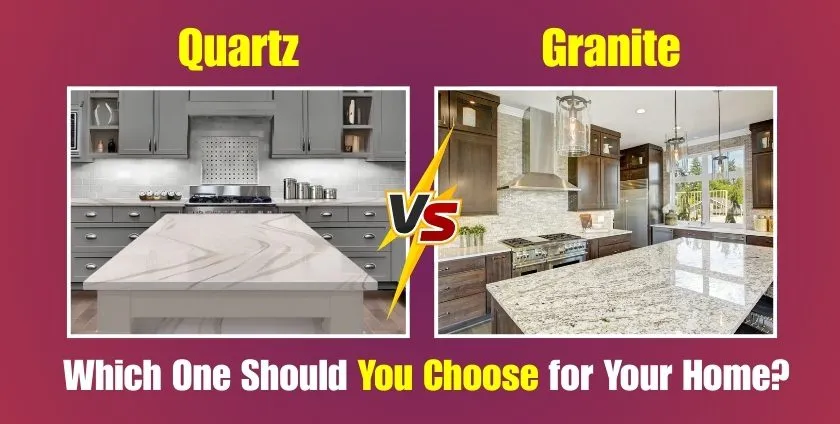
No material wins in every case. Choose quartz for consistent looks and low upkeep, granite for natural character and better heat tolerance, and marble if you accept the care it demands.
Want to read more about natural stone before you decide? See our guides on what granite is, its types and uses, granite vs marble for kitchens and how to identify high-quality granite.
How to Identify Good-Quality Engineered Quartz
- Ask for the data sheet. Get the manufacturer name and technical details.
- Check thickness. Confirm the actual measurement.
- Inspect the surface. Look for pits, uneven polish or visible flaws.
- View the full slab. Small samples can mislead on pattern and colour.
- Confirm the use. Make sure it suits your indoor or outdoor plan.
- Check the fabricator. Their experience matters as much as the slab.
- Get warranty terms in writing.
How to Clean and Maintain Engineered Quartz
- Wipe spills quickly, especially coloured or acidic ones.
- Clean with mild soap and water.
- Use trivets for hot pans and cutting boards for chopping.
- Avoid strong bleach, paint strippers and harsh solvents.
- Follow the manufacturer’s care instructions.
Where to See Engineered Quartz Slabs in Hyderabad
Photos rarely show how a slab looks under real light, so see full slabs in person. Compare white and marble-look designs side by side, check finishes, and ask for specifications.
GL Stone Expo in Kokapet, Hyderabad, offers stone and quartz options to compare. You can explore engineered quartz slabs before you visit.
Popular quartz designs to view in person include Pure White, Snow White, Taj Mahal, Nova Grey, Venetian Gold and Liri Gold.
Looking for quartz close to you? GL Stone Expo serves quartz in Hyderabad, quartz in Gachibowli, quartz in Madhapur, quartz in Manikonda and quartz in Tellapur. Planning the whole project? Also look at our granite and tiles ranges, browse the gallery for finished looks, or read the FAQs.
Conclusion
Engineered quartz stone is a manufactured slab made from natural quartz, resin and pigments, shaped through mixing, vacuum compaction, curing and polishing. It offers consistent colours, easy upkeep and wide design choice, which is why it is popular in kitchens and commercial spaces. It also has limits: it needs heat protection, is not meant for most outdoor use, and must be cut with proper dust control. Formulations differ between brands, so always check product specifications before buying. To compare options in person, visit GL Stone Expo in Kokapet and view the quartz collection. Have a question before you visit? Contact the GL Stone Expo team and they will guide you.
Frequently Asked Questions – (FAQs)
What is engineered quartz stone?
Engineered quartz stone is a manufactured surface made from crushed natural quartz, resin and pigments. The mixture is compressed and cured into slabs. It is mainly used for kitchen countertops, vanities and commercial counters because it offers consistent colours and patterns.
How is engineered quartz manufactured?
Quartz is crushed, mixed with resin and pigments, and spread into a mould. It is compacted under vacuum and vibration, then cured so the resin hardens. The slab is ground, polished and inspected for thickness, finish and colour consistency.
Is engineered quartz natural or artificial?
It is a combination. Quartz is a natural mineral, but the slab is manufactured using resin and pigments. That makes it an engineered product rather than a naturally formed stone like granite, marble or quartzite.
What is engineered quartz made of?
It is made of crushed natural quartz, resin binder, pigments and decorative additives. Quartz forms the larger share of the slab. Exact proportions differ by manufacturer, so check the product data sheet instead of relying on a general figure.
What is the difference between engineered quartz and quartzite?
Quartzite is a natural rock formed under heat and pressure, then quarried. Engineered quartz is factory-made from quartz particles and resin. Their appearance, natural variation and care needs differ, so they should not be treated as the same material.
Is engineered quartz better than granite?
Neither is better in every case. Quartz offers consistent patterns and often needs no sealing. Granite offers natural variation and generally better heat tolerance. Choose based on look, budget, kitchen use and how much upkeep you accept.
Is engineered quartz suitable for kitchen countertops?
Yes. It is widely used in kitchens because of its low porosity, wide colour range and easy cleaning. Use trivets for hot cookware, chopping boards for cutting, and choose an experienced fabricator for accurate cut-outs and support.
Is engineered quartz heat-resistant?
It tolerates normal kitchen use but is not heat-proof. Hot pans can cause discolouration or damage, and sudden temperature changes may lead to cracks. Always use trivets and check the manufacturer’s heat guidance for your product.
Does engineered quartz stain easily?
It resists most everyday stains because of its low porosity, but it is not stain-proof. Turmeric, wine and dark sauces can mark the surface if left for long. Wipe spills promptly and clean with mild soap and water.
Does engineered quartz need sealing?
Most engineered quartz products do not need sealing because they are generally low in porosity. Natural stones like granite and marble often do. Since products vary, check the manufacturer’s care instructions before deciding.
Can engineered quartz be used outdoors?
Usually not recommended. Resin-based surfaces can fade or degrade under prolonged sunlight and weather. Some products may be rated for limited outdoor use, so confirm suitability with the manufacturer before installing anywhere exposed.
Can engineered quartz crack?
Yes, though it is uncommon with good installation. Cracks usually result from sudden heat, heavy impact, or poor support around cut-outs and overhangs. Choosing a skilled fabricator and using trivets greatly lowers the risk.
How long does engineered quartz last?
With proper care and installation, it can serve for many years in a home kitchen. Lifespan depends on the product, fabrication quality, heat protection and daily use. Check written warranty terms rather than relying on general claims.
What are the disadvantages of engineered quartz?
Main drawbacks are heat sensitivity, possible chipping at edges, limited outdoor suitability, higher cost for premium designs and imperfect colour matching in repairs. Fabrication also needs proper silica dust control to protect workers.
How do you clean engineered quartz?
Wipe with a soft cloth, mild soap and warm water. Clean spills quickly. Avoid strong bleach, paint strippers and abrasive scrubbers, which can dull the surface. Follow the manufacturer’s care instructions for your specific product.
How do you identify good-quality engineered quartz?
Check the manufacturer’s data sheet, actual thickness and surface finish. Look for even polish, consistent colour and no visible pits or flaws across the full slab. Also ask about the fabricator’s experience and get warranty terms in writing.
Is engineered quartz suitable for bathroom countertops?
Yes. Its low porosity suits vanity tops, and cleaning is simple. Make sure edges and joints near basins are sealed and installed correctly, because water resistance does not mean the slab is waterproof.
Visit our Kokapet showroom or send us an enquiry — our team will help you choose the right stone, finish and size for your space.
Kokapet showroom · Open Mon–Sun, 9 AM – 8 PM
- By: Rajesh" >Rajesh
- Tags: Engineered Quartz Slabs, Engineered Quartz Stone, How Quartz Stone Is Made, Quartz Manufacturing Process, Quartz Stone Hyderabad
- Category: Blog, Quartz
- 0 comment
Leave a Reply