
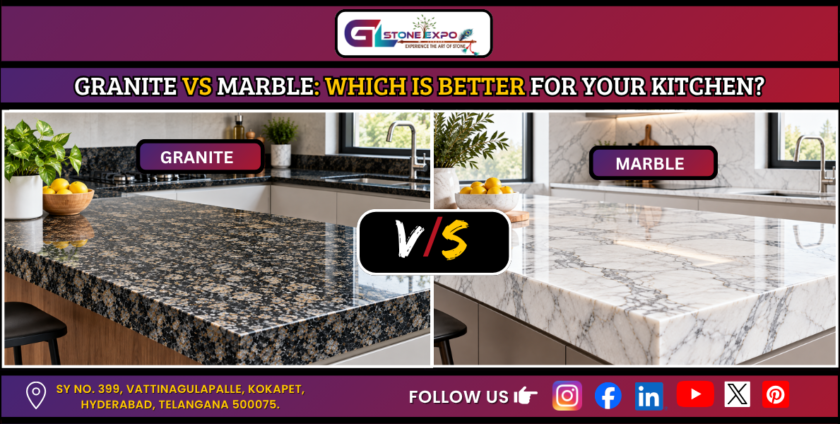
Granite vs Marble: Which Is Better for Your Kitchen?
Granite and marble are, almost without question, the two most favored natural stones for countertops, and the issue of how to choose between the two, granite versus marble, is quite possibly the most complicated question anyone will ever be faced with in their kitchen remodel. In terms of features, both granite and marble share most of the features, like both materials can withstand immense pressure, and they are not known to develop fractures under extreme pressure. However, when you take a deeper dig, the two materials start to differ in few areas:
In this article we compare the granite vs. marble countertops, on many important aspects, like; durability and maintenance levels, resistance towards heat as well as scratches and stains, compare these stones cost, appearance of both the stones, etc, and in the end the popularity of both the stones in an Indian kitchen. Read through all this information to see that if both the materials suit your needs and budget then which one you can pick.
What Is the Difference Between Granite and Marble?
Granite & Marble are in fact natural stones, the difference being that they form in totally contradictory processes which account for nearly all the information in the rest of the guide.
What Is Granite?
Granite & Marble are in fact natural stones, the difference being that they form in totally contradictory processes which account for nearly all the information in the rest of the guide. Also there is a vast palette of colour and texture-from muted beiges to rich black shot with golden or coppery flecks, which made it the most natural choice for kitchens across Indian homes.
What Is Marble?
Marble is originally a form of limestone and is transformed by heat and pressure over thousands of years to get the smooth flowing veins marble has. It’s one very beautiful stone and is a lot softer and more permeable than granite and this alone determines nearly all of the major practical differences between granite and marble.
How Do Granite and Marble Compare at a Glance?
| Feature | Granite vs Marble |
| Durability | Granite: harder, more scratch-resistant. Marble: softer, more prone to wear. |
| Cost | Both span a wide range; premium/imported marble can be pricier. |
| Maintenance | Granite is generally easier; marble needs attentive care against staining and etching. |
| Heat Resistance | Both tolerate normal heat well, but trivets are recommended for either. |
| Appearance | Granite: natural grains and flecks. Marble: flowing, luxury veining. |
If it is a kitchen that is used on a daily basis, granite wins in practicality. If it is a kitchen which is intended as much for visual purposes as functionality then marble should be the stone, as the maintenance comes with the stone.
How Porous Are Granite and Marble?
No natural stone is completely non-porous. While Granites will be much less porous than marbles, the amount will vary a lot. All marbles have much more overall porosity-a factor in their formation process-which causes them to readily absorb liquids. They therefore may not show staining, if maintained properly; nevertheless, such stains have more time to soak into the material-a function of which kind of stone you have and are willing to pay for is important to ask before you sign!
Which Is Easier to Maintain, Granite or Marble?
Granite usually does require less maintenance in terms of everyday care than marble, but it still doesn’t mean care-free. Some granite does not need sealing and in that event may not require a great amount of maintenance, while some might require ongoing care-ask your fabricator what needs to be done for YOUR granite. Just wipe up spills in a timely manner and clean it with mild, pH appropriate soap, and keep on whatever schedule sealing has told you it will need:
The marble is a material that asks for discipline, spilled acidic – lemon, tomato, tamarind, vinegar- must be immediately wiped down when detected. Use PH neutral, stone friendly cleaners, always avoid acids and any abrasive cleaners. Reapply sealer regularly and let marble develop its natural patina if it is an item in frequent use.
It’s a common misconception that sealing protects against etching. This is not the case. Sealing decreases liquid penetration of the stone thus decreasing the chance of staining, however etching is the chemical process between the acid and the carbonate in the marble which forms the counter top (or whatever it is) occurring AT THE SURFACE irrespective of sealer. Sealed marble counters still need to be wiped down or the lemon juice will dull it.
Which Is More Durable, Granite or Marble?
Granite offers higher everyday use durability. Hardness provides resistance to chips and scratches as well as wear. Its mineral matrix, tightly packed, is resistant to dings from knife slips or falling cookware and ladles.
Even though marble can be perfectly durable in a kitchen for decades, the softer stone will gradually accumulate hairline scratches over the years and the edges and corners can be less resilient. Both stones will chip with a sharp, heavy impact, although marble is more susceptible to more everyday chipping. It is unusual to get a hairline scratch on granite, while marble will develop these readily, and these will at least sometimes be buffable.
Etching on marble is sometimes treatable with professional honing or re-polishing and extreme etching may require a larger patch to be refurbished.
Which Has Better Heat Resistance, Granite or Marble?
Granite is highly resistant to heat and the majority of the time will be perfectly fine under a hot pan. It does not mean to say heat proof though and a temperature shock, or an undiscovered fault in the material, could well cause a crack developing later in time and so using a trivet is best practice. Marble tolerates normal kitchen heat quite well, but can be more sensitive to thermal shock, especially around an existing crack, thin edge, or a seam, so keep a trivet handy for either.
Which Scratches and Stains More Easily?
Marble scratches more readily as it’s a softer stone. Granite is porous and could stain however in normal use, a porous stone or poorly sealed granite will stain if something like oil is spilt and left standing on the surface or curry and turmeric spills are not cleaned up promptly. Stains are a liquid soaking in; etching is a chemical reaction where there is no discoloration at all but the surface has become dull.
Which Finish Is Best for Granite or Marble in a Kitchen?
A polished finish (shiny, this is the favorite choice for both stones as it makes the color and veining stand out), but with marble it shows etch marks a lot more obviously. Honed finish (matt) camouflages etches and slight scratches, at the price of slightly less shine and an altogether softer finish.
A leathered/textured finish is good for hiding fingerprints and water marks and also the minor blemishes to some extent from both stones but it costs more and should be installed by someone experienced. There isn’t necessarily a best finish; it’s a trade-off between how much wear you’re willing to accept over years against the level of shine you wish on day one.
Does Installation Affect How Granite or Marble Performs?
Stone quality isn’t the sole criterion; its fabrication is of equal importance. In either material the stone needs good support, particularly at sink cut outs, which should be cut precisely with eased corners rather than square corners (a starting point for a crack). Bigger kitchens may require joints in the stone – these are barely visible when skillfully fabricated.
The edge detail influences both aesthetics and susceptibility to chipping – a square, eased, or bevelled edge is least likely to chip, whereas complex profiling like ogee creates increased vulnerability, especially for marble.
Large kitchens that require island seating with an overhang require the stone to be supported with steel bracing or corbels underneath regardless of the stone.
Which Is More Affordable, Granite or Marble?
Granite normally works out cheaper that marble however like there is noset costs with either its all down to choice and from where the stone came from, its colour and rarity of the pattern, what width and finish you want.
As a rough guide an estimate quotation will include; slabs, cutting, work-top, cut outs, edgings, seams, delivery, installation and sealing and often a cheap price ticket doesn’t actually mean cheaper.
Though some cheapest slabs are often cheap value though- mid price granite that will withstand ten years of cooking could be value rather than a cheaper marble you could rely on a professional, although if using marble for a feature it will be value.
Which Looks Better, Granite or Marble?
This is down to taste, not technology. Granite shows natural texture-mineral flecks, grain and variance in vast colours. Marble appears softer and more liquid- with veining that never reproduces itself-white/neutral marble colourways have a sophisticated, expensive effect.
Marble “reads” as more “luxe” due to the vein effect but striking granite could just be as dramatic in color and pattern.
All natural stones vary from slab to slab, so always look at the actual slab before it’s cut, not the sample chip.
What Are the Pros and Cons of Granite and Marble?
Granite Pros and Cons
● Durable, generally scratch-resistant, and handles heat well
● Easier to live with day to day; wide range of colours and patterns
● Some varieties still need regular sealing; rarer colours can get expensive
Marble Pros and Cons
● Distinctive, one-of-a-kind veining and a refined, high-end look
● Naturally cool surface, handy for pastry and dough work
● Softer and more prone to scratching and acid etching; needs more attentive care
Which Is Better for an Indian Kitchen, Granite or Marble?
This is one type of stress the Indian kitchen has to live with every single day: intense heat, oil, turmeric, masala, lemon, tomato and tamarind, being on and off the stove with immense weight in vessels and being wiped down multiple times a day and if your Indian kitchen is a busy place the forgiving nature of granite becomes ideal against oil stains and spices and cleaning.
Marble is a potential winner if the look is so paramount to the person and they are prepared to do all it takes to care for it with instant wipe down after acid contact and correct cleaning product and accept it will continue to patinate naturally.
Which One Should You Choose for Your Kitchen?
| Priority | Better Fit | Why |
| Heavy daily cooking | Granite | More forgiving under heat, spills, and constant use |
| Lower maintenance | Granite | Less attentive care required day to day |
| Scratch resistance | Granite | Harder mineral structure resists marks |
| Distinctive veining | Marble | One-of-a-kind natural pattern |
| Design-focused kitchen | Marble | Refined, high-end visual character |
| Luxury appearance | Marble | Often perceived as the premium look |
Conclusion
Granite is best for the real daily usage of a kitchen, that means cooking, heat and spills. For a kitchen “feeling”, marble has the beauty no one can’t look at-it is a different experience by requiring the consumer to take a bit of care. Neither of them is “right” material, it really depends on comparing cooking style, tolerable level for maintenance with cost.
Lastly check real slab with lighting, the finishing with slab’s thickness, and the edge finishing in per person at your kitchen before installation. In addition make sure to have full cost not only for slab.
Frequently Asked Questions (FAQs)
Is granite better than marble for kitchen countertops?
Granite is typically the more durable, low-maintenance option for day-to-day use, while marble provides a classic, upscale look if that takes precedence over ease of care.
Is granite cheaper than marble?
A: Generally, yes. However, both materials come in a wide range of price points based on the specific variety, origin, thickness and finish – always get a price estimate for the actual slab.
Which is more durable, granite or marble?
A: Granite. It is harder than marble and will scratch and chip more readily.
Which is easier to maintain, granite or marble?
Granite. Less sealant is usually needed than for marble, and acid spills are much less likely to leave a lasting mark on a granite surface.
Can you put hot pans on granite?
Yes, Although, using trivets for very hot dishes to prevent thermal shock-still a possibility with granite- is recommended.
Can you put hot pans on marble?
Yes, However marble is more sensitive to temperature changes, especially if there are existing cracks in the stone that may become larger due to excessive heat-use trivets diligently for hot items.
Does marble scratch more easily than granite?
Yes, Marble’s comparative softness makes it susceptible to fine scratches from knives and cookware; therefore use cutting boards regularly.
Does granite need to be sealed?
In most cases yes. However, granite can vary; ask the fabricator as part of the planning process whether your preferred selection requires sealing, and when and how often.
Can granite stain?
Yes, though less commonly than marble, Granite will absorb anything from acid spills, to things like oils or food coloring which have been allowed to seep in.
Can lemon juice or tomato damage marble countertops?
Yes, Acidic spills will “etch”-a dull ring-onto your polished marble if allowed to sit. Wipe any spills of this nature very promptly.
Does sealing marble prevent etching?
No, sealing limits absorption while preventing marks from acids. You may need to resurface your counters in addition to resealing them annually or bi-annually to remove etching.
Can etched or scratched marble be repaired?
Generally yes, Marble can be honed down, the process may reveal the underlying stone so for seamless work it should cover a slightly larger area and possibly be done expertly.
Is marble a bad choice for a kitchen?
No, A skilled, attentive cook will find marble a suitable countertop, though it requires careful maintenance to remain looking new. Granite is recommended for busy home cooks.
Is marble a good choice for an Indian kitchen?
Depending on the cook! Use of a lot of strong colored spices will mean vigilance against staining, granite is generally a less fussy material for heavy day-to-day use.
Which looks more luxurious, granite or marble?
For the most part, marble conveys the sense of luxury owing to the characteristic free-form veining, although striking examples of granite may equal this with careful selection.
Does the finish affect how granite or marble performs?
Yes, a polished finish has high gleam revealing deep veins but any scratches are amplified. A honed (matted finish) will not show the etches nor show very fine scratches.
Will a natural granite or marble slab look exactly like the showroom sample?
No, Always view the actual slab from which the cut will be made as stone patterns vary from lot to lot and between showroom samples and the actual slabs.
How long do granite and marble countertops last?
With careful and regular attention granite and marble can both survive many decades! Lifespans vary by each type as does the manner of its use.
What slab thickness is best for a kitchen countertop?
This really comes down to appearance and usage. The popular thickness options of 2cm and 3cm are generally considered to be equally sturdy although 3cm will give a better feel at the edge of your island or peninsula if it has an overhang; ask your installer.
Do kitchen islands need extra support for granite or marble?
If the island has a substantial overhang designed for seating, it should indeed be supported, either by corbels attached securely below the underside or by a strong steel bracket set into the supports underneath.



- By: Rajesh" >Rajesh
- Tags: Granite Countertop, granite kitchen, granite kitchen countertops, granite or marble for kitchen, granite vs marble, granite vs marble appearance, granite vs marble countertops, granite vs marble durability, granite vs marble for Indian kitchen, granite vs marble heat resistance, granite vs marble kitchen, granite vs marble maintenance, granite vs marble price, granite vs marble pros and cons, kitchen countertop comparison, kitchen stone countertops, marble countertop, marble kitchen, marble kitchen countertops, natural stone countertops
- Category: Blog, granite
- 0 comment
Leave a Reply