
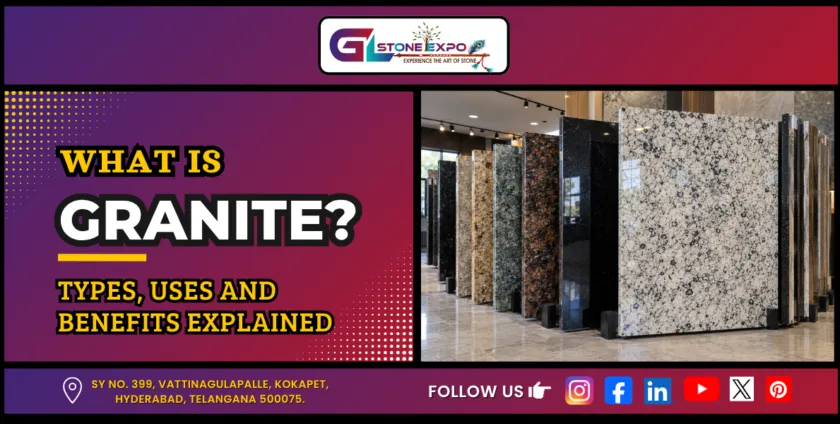
What Is Granite? Types, Uses and Benefits Explained
Granite is a natural igneous rock that is primarily composed of quartz, feldspar, and mica. It is formed when magma cools down gradually beneath the earth’s surface. The slow cooling process gives granite its dense and granular crystalline structure that makes it highly scratch-resistant, extremely durable, and tough to heat.
These properties make granite a popular choice of material for countertops and flooring and for exterior building construction as well. This write-up includes everything one needs to know about this versatile rock, including its formation, types, uses, and the price per square meter in Hyderabad that one can expect to pay nowadays.
What Is Granite?
Granite is a coarse-grained igneous rock of quartz, feldspar, mica, and trace minerals. The distribution of these materials is different for each slab, which means that no two granite stones are the same.
The rock consists of at least two ingredients capable of independent formation. Thus, granite can possess a wide range of colors and patterns depending on the prevailing minerals. For example, quartz has a hardness of 7 on the Mohs scale, meaning that it can resist a steel knife’s scrape. Such properties make granite highly desirable in the kitchen industry for countertops, floor tiles, and other uses before the invention of engineered stone countertops.
How Is Granite Formed?
Granite is formed when molten magma cools down gradually under the earth’s surface over an extended period of time and can take hundreds or even millions of years to cool down completely. When magma cools down slowly it creates a granular structure with large mineral elements making it obviously different from quickly cooled rock like basalt.
The formations then go through geological processes that make them available for quarrying at outcrops near or at the surface. In India, granite belts are found in several states like Andhra Pradesh, Telangana, Karnataka, and Rajasthan which also happens to be one of the oldest rock formations in the world. This means south Indian granites like the Kuppam Green and Tan Brown are quarried near their place of sale reducing expenses incurred during transportation.
What Are the Different Types of Granite?
Granite is generally classified by color, since color is the biggest factor in both appearance and price.
| Type | Typical Color | Best For | Approx. Price (₹/sq ft) |
| Black Galaxy | Black with gold flecks | Premium countertops | 110 to 220+ |
| Absolute Black | Solid black | Countertops, monuments | 90 to 180+ |
| Tan Brown | Brown with dark speckles | Flooring, countertops | 70 to 150 |
| Kuppam Green | Green, coarse grain | Flooring, cladding | 75 to 200+ |
| Alaska White | White with grey/black flecks | Modern kitchens | 100 to 220+ |
| Steel Grey | Grey, fine-medium grain | Flooring, stairs | 60 to 130 |
Domestic Indian granite is generally cheaper than imported slabs from Brazil or Italy. This is mainly a freight cost difference, not a quality difference.
What Are the Common Uses of Granite?
Granite’s high hardness and heat resistance makes its application in both residential and commercial settings. Here are the primary uses of granite:
- Kitchen countertops – It is resistant to heat from cookers and scratches from knives
- Flooring – It is used in homes, offices, hotels, and hospitals
- Staircases – It resists constant pressure, thus, it does not chip
- Wall cladding and building facades – It requires low maintenance
- Monuments – It is durable to bear engravings and withstand outdoor conditions
- Bath vanities – It is highly resistant to water once it is sealed
The slab’s thickness depends on its intended use. For instance, one can expect to find 18-20mm thick slabs in the floor and 16-18mm thick slabs for kitchen countertops. The latter is preferred since it reduces pressure on cabinets.
Where Is Granite Used in Homes and Buildings?
For home applications, the first application for granite is countertops for kitchens, second is for bathrooms (vanities), third is for the floor (in areas like entryways, and living room), fourth is for staircases.
For commercial buildings, its application for flooring in high traffic areas of hospitals, hotel lobbies, or entry ways, due to its resilience against wear from heavy traffic, it application for walls (exterior cladding) of commercial buildings, as the weather does not bother it with a lot of care.
How to Choose the Right Granite
Four points dictate your choice of slab:
- Finish – Polished is suitable for indoor applications as it can be quite slippery if wet, therefore an outdoor application such as steps or a patio surface requires a leathered or flamed finish for slip resistance.
- Sealing – Double-check whether this is included within your quotation. An unsealed slab is absorbent and stains extremely quickly upon exposure to oil or wine- it can be damaged within hours.
- Thickness – This varies depending on use; 16-18mm is common for countertops whilst 18-20mm may be specified for floor finishes.
- Cost – Domestic granite within Hyderabad will vary between approx 60-220/sq ft depending on shade, with installation approx 20-50/sq ft on top of this.
Ensure you compare both domestic and imported varieties before deciding on the appearance that you need for a slab that can only be provided as imported stone.
It is imperative that you view a slab of what you choose in person before purchasing. Small chips do not depict what a pattern on the slab of a complete floor or counter may entail.
What Are the Benefits of Granite?
The key advantages of a granite worktop installation would appear to be the granite’s durability and ease of care. When sealed effectively, the stone is of use for around 25 years if not longer and is more resistant to scratches and heat than a lot of other surfaces out there. Furthermore a granite worktop increases a home’s value significantly (as opposed to laminate and vinyl countertops). As it is stone every one of the granite slabs is original creating a unique product.
The major disadvantages of granite worktops would appear to be their weight and the need for resealing: Granite is obviously not a light material; strong kitchen cabinets or subfloor would seem a must and sealing is needed to re apply every 12 -24 months. It is more expensive than laminate initially but if the average service life of laminated worktop is generally only 10 to 15 years as it is usually replaced with a more permanent fixture, granite works out to be a cheaper alternative overall.
Granite vs Marble: What’s the Difference?
| Factor | Granite | Marble |
| Hardness | Harder, more scratch-resistant | Softer, scratches more easily |
| Heat resistance | Excellent | Good, but can discolor under prolonged heat |
| Porosity | Lower once sealed | More porous, stains more easily |
| Appearance | Speckled, granular pattern | Veined, smoother pattern |
| Best for | Kitchens, flooring, exteriors | Bathrooms, low-traffic decorative surfaces |
| Typical cost | Often lower for comparable quality | Often higher, especially imported varieties |
For kitchens and flooring, granite is more practical due to its durability and requires less maintenance. Marble is preferred for embellishment and in places where it will not be subject to wear and tear but its veined patterns are desired.
Conclusion
The cost of granite balances rarity, strength and beauty on a budget when compared with most import materials. A granite slab requires thoughtful consideration to fit within a defined budget, selection of preferred colors and finishes, and confirmation that the chosen thickness is appropriate for its intended application.
It is also ideal to examine your granite sample in the very lighting the counter will be in before placement. Current price of granite in Hyderabad, in stock colors and to order an estimate, please call GL Stone Expo showroom or order a quote online.
Frequently Asked Question – (FAQs)
What is granite?
Granite is a natural occurring igneous rock that is quarried from the earth unlike engineered quartz surfaces, which is comprised of quarried stone and the polymer resins that are used to hold it together.
Is it a stain-resistant material?
No, if sealed it is much stain-resistant. If granite isn’t sealed it may stain as a result of absorbing liquids, such as oil or wine (in only 4-6 hours), permanent. In order to prevent granite from being stained you should reseal it at least every 1-2 years.
How long does granite last?
Proper sealing and upkeep will last forever. The floor or counter may last as long as 25 years and much more.
Can granite be used for floor in a heated climate?
It’s cool under foot in a heated climate. In the summer it’s a much nicer material to walk bare-foot on than that of cement or wood. However, in direct sunlight it is subject to heating up under direct sun, unless of a lighter color.
What makes granite countertops such a good choice for a home?
Granite withstands scratching and heating far better than laminate or manufactured surfaces, and no two pieces being the same always adds the aesthetic appeal you’re searching for in a kitchen.
Is granite a superior material to marble when in a kitchen environment?
In the general case, yes, because of it’s much greater hardness, density, and porosity, and it’s therefore less of a burden to maintain than marble.
What is the typical cost for granite in Hyderabad, per square foot?
A single square foot of domestic granite costs between 60 to 220 Rupees a square foot depending on the granite selection of either color or the grade quality desired, with approximately 20 to 50 rupees extra per square foot for installation.
How is polished different than leathered granite?
Polished granite can be recognized by its sleek and shiny surface while leathered has a more matte or texture finish and is excellent at hiding water spots and fingerprints, also commonly found on darker colored stone and an outdoor flagstone solution.
Visit our Kokapet showroom or send us an enquiry — our team will help you choose the right stone, finish and size for your space.
Kokapet showroom · Open Mon–Sun, 9 AM – 8 PM


- By: Rajesh" >Rajesh
- Tags: granite applications, granite benefits, Granite Countertops, Granite Flooring, granite price in Hyderabad, Granite Slabs, granite stone, granite types, granite uses, granite vs marble, types of granite, what is granite
- Category: Blog, granite
- 0 comment
Leave a Reply