
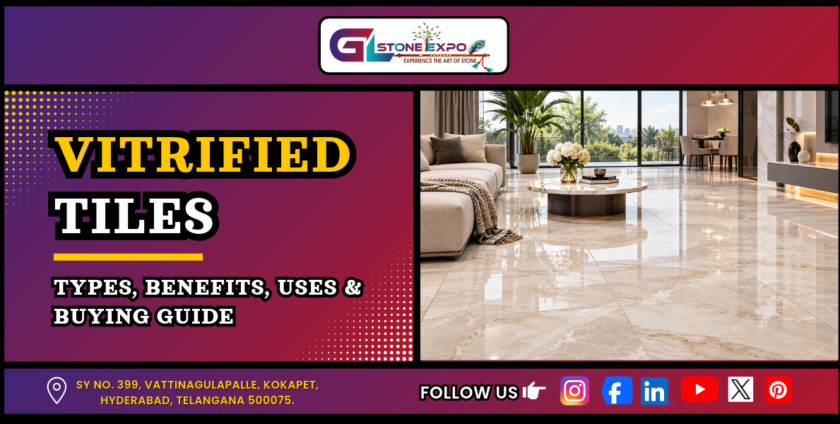
Vitrified Tiles: Types, Benefits, Uses & Buying Guide
Vitrified tiles refer to dense and low-porosity tiles which are made possible by fusing the body of the tiles through very high temperature heating of clay, silica, and feldspar to make them absorb very little water content. These tiles are commonly seen throughout the city of Hyderabad, starting right from apartments located in Kokapet and Gachibowli.
The following is the tricky part: “Vitrified” covers a wide range. Double chargers, full-body vitrified tiles, glazed (GVT) tiles, and digital tiles all come under this category, and they all have their own characteristics when placed in different areas of the home, such as the kitchen, the living room, or a wet entrance area due to rain.
What Are Vitrified Tiles?
Vitrified tiles are subjected to vitrification; in the course of firing, certain substances melt and combine together to form the body and close the pores. Tiles that absorb water in an amount of 0.5% or less are normally categorized as low-absorption in accordance with industry standards, but the values can differ depending on the product.
How Are Vitrified Tiles Made?
| Stage | What happens |
| Preparation and grinding | Clay, silica, and feldspar are mixed with water and ground to powder. |
| Pressing and drying | The powder is pressed into slabs and then dried to prevent cracking. |
| High-temperature firing | Fusion of the body in a kiln. It is called vitrification. |
| Finishing and inspection | The tiles are polished, glazed, printed, or left matt. They are tested for their dimensions and defects. |
What Are the Different Types of Vitrified Tiles?
The names are related because a tile could be a digitally printed GVT that has a glossy surface. They are just different terms used to describe the construction and decoration of tiles.
| Type | How it is made | Commonly used in |
| Double charge | Two layers pressed together; thicker pigmented top layer gives a stone-like look | Living rooms, bedrooms, offices |
| Full body | Colour runs through the full thickness, so chips are less visible | Corridors, showrooms, busy areas |
| GVT | Glazed surface printed with a design; huge pattern range | Homes and commercial interiors |
| Digital | Inkjet-style printing for realistic marble, wood and stone effects | Living areas, feature walls |
In practice, full body tiles are better for where chips will show up, and GVTs and digital tiles are better for where looks are important. Double charge tiles fall somewhere in between, with a thick decorative layer that wears slowly.
Polished or matt? Finish refers to the surface, not the tile body, and it’s one of your most practical options.
| Polished | Matt | |
| Look | Glossy; makes rooms brighter | Soft, calm, non-reflective |
| Marks | Shows footprints and water marks | Hides marks better |
| Grip | Can be slippery when wet | Usually more grip, depending on product |
| Often used in | Living and dining areas | Kitchens, balconies, entrances |
What Are the Benefits of Vitrified Tiles?
- Water resistance: it resists any type of staining.
- Durability: It takes care of foot traffic if selected and laid correctly.
- Easy to clean: Due to its compact and smooth texture it becomes easy to clean.
- Types of vitrified tiles: Many types such as marble, wooden, stone, or even plain surface tiles are available.
- Flexibility: Different sizes and textures may be used as per requirement in homes, offices, or showrooms.
Not all vitrified tiles have the same features, so it becomes very necessary to go through its specification before buying it.
What Are the Limitations?
| Limitation | What it means for you |
| Slipperiness | Polished tiles can be slippery when wet. |
| Hard to cut and install | Dense tiles need skilled installers and a level base. |
| Replacement | Matching tiles may be discontinued, so keep spares from the same batch. |
| Chipping | Heavy impact can chip corners and edges. |
All of them can be overcome. The vast majority of issues stem from selecting an unsuitable coating for the room or from poor workmanship, both of which can easily be prevented.
Where Can Vitrified Tiles Be Used in Hyderabad Homes?
Vitrified tiles in Hyderabad are mostly installed either in case of new constructions or renovations. There are specific environmental factors that must be taken into account: monsoon moisture at entrance and balcony areas and fine dust, which becomes easily visible on polished floors.
| Space | Finish to consider |
| Living and dining room | Polished or glossy GVT, digital or double charge |
| Kitchen floor | Matt or textured tiles for better grip |
| Bathroom, balcony, entrance | Matt or anti-skid tiles suited to wet areas |
| Bedroom | Soft matt or wood-effect tiles |
| Office or showroom | Full body or large-format polished tiles |
Open plan apartments and villas are prevalent in the city, and large-sized tiles will make such spaces appear as one coherent space. It is recommended that families with young children and older people carefully examine the grip factor.
How to Choose the Best Vitrified Tiles for Your Home
- Start with the space. A bedroom and a kitchen have different needs.
- Choose the finish. Polished for shine, matt for grip.
- Check slip resistance for wet or high-risk areas.
- Pick the size. Large formats such as 800 x 800 mm or bigger mean fewer joints but need skilled laying; 600 x 600 mm is easier to handle.
- Review specifications: thickness, water absorption and strength.
- See the tiles in person, checking shade, flatness and edges across boxes.
- Order extra for cuts and breakage, all from one batch, to avoid shade differences.
Size changes how a room looks and how tricky laying becomes. These formats are commonly seen, but availability varies, so confirm stock with your supplier.
| Size (mm) | Best suited to |
| 600 x 600 | Most rooms; easy to handle |
| 600 x 1200 | Making rooms feel longer |
| 800 x 800 and above | Open-plan areas with fewer joints; needs skilled laying |
Vitrified Tiles vs Ceramic and Porcelain Tiles
| Factor | Vitrified | Ceramic |
| Firing and body | Higher temperature; denser | Lower temperature; more porous |
| Water absorption | Typically much lower | Generally higher |
| Durability | Generally harder; suits heavy use | Better for lighter use |
| Typical use | Floors in living and commercial areas | Walls and low-traffic areas |
Vitrified and porcelain overlap heavily, and “vitrified” is simply the more common trade term in India. Since labels vary by brand, compare the water absorption, thickness and finish of the exact tile.
Installation and Maintenance Tips
- Installation: make sure to lay the tiles on a clean, flat, cured subfloor using an appropriate adhesive for heavy tiles. Lay dry first before joints fully cure.
- Daily maintenance: clean frequently by sweeping and mopping using pH neutral cleaning agents.
- Stains and grout: clean up all stains as soon as possible, use only gentle cleaning products and seal grout.
- Protect: put down door mats and protect furniture legs by using felt, do not drag heavy items over the surface.
Tip: Take some tile samples home and view them under your lighting with your walls and furniture around you – colors change from what you see in the store.
How to Select a Reliable Vitrified Tiles Supplier in Hyderabad
Check out different finishes and sizes, well-defined specifications, quality consistency among batches, informed sales people, and showroom with lighting to see your tiles in actual light.
Find out if there is batch consistency, sample consistency to entire box, and how much help they give in installer selection. Reputable sellers present tradeoffs of different tiles, rather than trying to sell you the same tile for all spaces.
GL Stone Expo is a stone and tile showroom located at Kokapet, Hyderabad, India at Sy No. 399, Vattinagulapalle, Kokapet, Hyderabad, Telangana 500075.
Conclusion: Choosing the Right Vitrified Tiles
Choice of the proper vitrified tile would depend upon several factors related to the area of application, texture, design, maintenance, and technical requirements. Comparisons may be done among different types of tiles, slip resistance could be ascertained, technical specifications could be sought, and actual viewing of tiles should be done prior to purchase. It will pay to take some time now in order to avoid regrets later, as flooring needs not be redone.
Frequently Asked Questions – (FAQs)
1. What are vitrified tiles made of?
These tiles are produced from clay, silica, and feldspar among other minerals. These materials are crushed, molded, and baked at high temperatures to produce a dense and porous tile.
2. Why do vitrified tiles have low water absorption?
The high-temperature process ensures that the components combine to seal off most of the small pores in the body of the tile. As there are very few pores, very little water is absorbed, hence making the tile stain-resistant.
3. What are the main types of vitrified tiles?
The different types of tiles include double charged, full-body, glazed (GVT), and digital vitrified tiles that come in both polished and matte options. These kinds of tiles overlap, and thus, a tile can fall under all four categories.
4. Are vitrified tiles suitable for kitchens and bathrooms?
Absolutely, as long as you use the proper finish. Generally, matt or textured tiles provide more traction compared to polished tiles, so make sure that you select these types of tiles for wet floors.
5. Which finish is best for a living room?
Polished and shiny finishes are common as they reflect light and increase brightness in the room. Matte finishes work well for houses that prefer a more subtle appearance and do not want any footprints to be seen.
6. What is the difference between GVT and double charge tiles?
GVT has an impression design beneath the glazing, thus permitting very intricate designs. The double charged tiles have a thick pigment-based design pressed on to the base material that is preferred for its longevity of wear.
7. How do I clean and maintain vitrified tiles?
Sweep regularly and mop with a mild, pH-neutral cleaner. Wipe spills quickly, avoid harsh acids and abrasive scrubbers, and keep grout joints clean and sealed. Door mats at entrances limit the grit that dulls surfaces.
8. How do vitrified and ceramic tiles differ?
The vitrified tiles are fired at much higher temperatures, and hence they are denser as compared to the porous nature of ceramic tiles which are lightweight and hence easy to cut.
9. How many extra tiles should I order?
Purchase extra material due to cuts, corners, and breakage. More material will be needed for installation in a pattern or on a diagonal. Check with your installer for the right amount to buy, and purchase all your material from the same batch.
10. Where can I buy vitrified tiles in Hyderabad?
Check out tile showrooms that have extensive ranges, proper specifications, and professional personnel. GL Stone Expo in Kokapet encourages all homeowners, interior designers, and constructors to visit the showrooms to view vitrified tiles firsthand.
Visit our Kokapet showroom or send us an enquiry — our team will help you choose the right stone, finish and size for your space.
Kokapet showroom · Open Mon–Sun, 9 AM – 8 PM


- By: Rajesh" >Rajesh
- Tags: Best Vitrified Tiles for Flooring, Double Charge Vitrified Tiles, floor tiles in Hyderabad, Full Body Vitrified Tiles, GL Stone Expo, Glazed Vitrified Tiles, Types of Vitrified Tiles, Vitrified Floor Tiles, Vitrified Tiles, Vitrified Tiles for Home, vitrified tiles in Hyderabad, Vitrified Tiles in Kokapet, Vitrified Tiles Showroom in Hyderabad, Vitrified Tiles Supplier in Hyderabad
- Category: Blog, Tiles
- 0 comment
Leave a Reply