
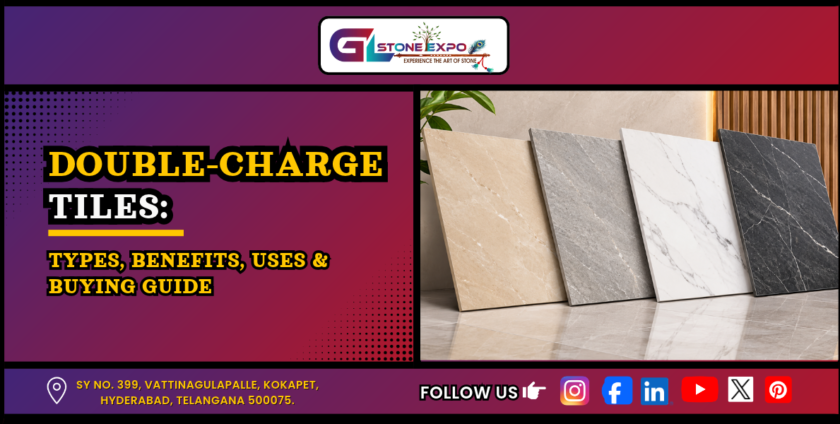
Double-Charge Tiles: Types, Benefits, Uses & Buying Guide
Double charge tiles are ceramic tiles which are formed by compressing two layers together, the bottom layer being the body and the top layer being a thin colored layer. This is the reason why people select double charge tiles as floor tiles for their houses since they give the effect of stone at much less cost than actual stones.
This guide explains how double charge tiles are made, where they work, where they don’t, how they compare with full body and PGVT tiles, and what to check before you pay for a single box.
Key Takeaways
• Double charge tiles have two pressed layers: a base body and a decorative top layer.
• They suit dry, indoor residential floors and offices or showrooms with moderate traffic.
• Full body tiles are usually the safer pick for very heavy traffic; PGVT suits a glossy, printed look.
• Always check the product specification and cut edge. Looks alone can’t confirm the tile type.
What Are Double Charge Tiles?
Double charge vitrified tiles are made by pressing two layers of material together before firing. The lower layer forms the body of the tile. The upper layer is a finer, coloured mix that gives the tile its look. Once fired, the two layers act as one tile.
What is meant by double-charged vitrified tiles?
Charge is the tile industry’s word for a measured load of powder fed into the press. Double charge simply means the press is loaded twice: once for the body, once for the decorative top. A single charge tile uses one mix all the way through.
The top layer is why these tiles can show marble-like veining or soft granite speckles. A conventional single-layer tile has only one mix to work with, so its design options are narrower.
Related Posts
• What Are Tiles? | GL Stone Expo Expert Guide
• Complete Guide to Types of Tiles | GL Stone Expo
How Are Double Charge Vitrified Tiles Manufactured?
Double charge vitrified tiles are produced using a process where body powder and colour powder are added to the press separately, pressed together to form a single mass and fired in a kiln. Each process has to follow a certain sequence and plays a role in determining the final product.
1. Raw materials are prepared. Clays, feldspar, quartz and other minerals are selected and checked.
2. Mixing and processing. The materials are ground, blended and dried into a fine, free-flowing powder.
3. The base layer is formed. A measured amount of body powder is fed into the press mould.
4. The decorative layer goes on. A second powder, coloured with pigments, is spread over the base. This is the layer you see and walk on.
5. Both layers are pressed together. High pressure compacts them into a single slab.
6. The tile is fired. Firing in a kiln fuses the particles and gives vitrified tiles their dense, low-porosity body.
7. Finishing and inspection. Surfaces are finished, edges are checked, and tiles are sorted by size and shade.
The pigmented layer decides the tile’s colour, pattern and surface feel. A manufacturer who controls this layer well gives you a floor with consistent shade from box to box.
Related Posts
• What Are Tiles Made Of? Tile Materials Explained
• Complete Guide to Tiles: Types, Sizes, Designs & Uses Explained
What Are the Benefits of Double Charge Tiles for Home and Commercial Floors?
The benefits below are general. Actual performance depends on the manufacturer and the specific model, so read the data sheet.
- A hard-wearing decorative surface. The pattern is part of the tile body, not a thin print. For a family home with normal walking, that is usually enough.
- Everyday wear resistance. Many ranges handle daily footfall and furniture, but check the product’s rating and don’t assume.
- A stone-like look. Double charge tiles design choices include veined, speckled and cloud-patterned surfaces, which suit people who like the feel of marble or granite.
- Good for residential floors. They suit living rooms, bedrooms and dining areas well.
- Many colours and designs. From warm beige to deep grey, there is usually something for most interior schemes.
- Simple routine cleaning. A mop and a mild cleaner cover most of it.
- Selected commercial use. Offices and showrooms with moderate traffic often use them.
No tile is scratch-proof or stain-proof, and double charge tiles are no exception. A gritty shoe sole or a spilt turmeric curry left overnight can still cause trouble.
Where Can Double Charge Floor Tiles Be Used?
Double charge floor tiles can be used in nearly all indoor dry environments. The coating is more important than the type of tile; a high gloss coat will look perfect in a drawing room but may be slippery in proximity to a bathroom or kitchen.
| Application | Suitability Considerations |
| Living Room | Design, finish and foot traffic |
| Bedroom | Comfort, appearance and maintenance |
| Dining Area | Cleaning and surface finish |
| Office | Foot traffic and wear characteristics |
| Showroom | Traffic levels and maintenance |
| Hallway | Durability and surface finish |
The hallways and entrances are the most abused areas, since everybody steps in there with dirt on their shoes. In case you decide to lay tiles here, request that the tiles have a texture finish, since they are more resistant to scratches and damage. The safest places for laying tiles in apartments are the living room and bedrooms.
Double Charge Tiles vs Full Body Tiles vs PGVT Tiles
These three types get mixed up all the time, even by sellers. The difference is mostly in how the surface is made.
- Double charge: Two pressed layers, with a pigmented top over a base body.
- Full body: One mix with colour and material running through the whole thickness.
- PGVT (polished glazed vitrified tile): A printed glaze is applied on the surface and then polished to a high shine.
| Comparison Factor | Double-Charge Tiles | Full Body Tiles | PGVT Tiles |
| Construction | Two pressed layers | Colour and material extend through the body | Glazed and polished surface |
| Design | Decorative upper layer | Pattern and colour throughout | Wide range of printed designs |
| Surface appearance | Generally stone-inspired | Depends on product | Glossy, polished appearance |
| Wear characteristics | Depends on decorative layer and specifications | Surface damage may be less visually noticeable | Depends on glaze and product specifications |
| Common applications | Residential and selected commercial flooring | High-traffic applications | Decorative residential interiors |
Performance and construction differ from brand to brand and even from product range to product range, so consider this chart as a point of departure, but nothing more.
Are there any differences between full body and double charge tiles?
No tile type is better all over the place. In case your floor needs to stand heavy loads of traffic, be it a shop, clinic, or a school corridor, full body tiles would be a good option because any chipped spot will blend with the rest of the floor. If you need a natural look of a floor for your house or office, double charge tiles would work.
Related Posts
• Complete Guide to Tiles: Types, Sizes, Designs & Uses Explained
• Complete Guide to Types of Tiles | GL Stone Expo
How to Identify Double Charged Vitrified Tiles?
The reliable way to identify double charged vitrified tiles is to check the product specification and look at the cut edge of a sample. You can’t tell from the front. A glossy.
PGVT and a double charge tile can look similar when you stand over them, so appearance alone proves nothing. Here is what to do instead.
- Ask the seller for the product specification and which category the tile belongs to.
- Read the manufacturer’s own product description and catalogue.
- Look at the cross-section of a sample piece or a broken edge, if the showroom has one.
- A double charge tile shows a visible top layer sitting over a different-looking body.
- Compare the top layer with the base. A full body tile won’t show that split.
- Ask for the technical data sheet and check the classification.
If a seller can’t tell you what the tile is, treat that as a warning sign in itself.
Are Double Charge Tiles Good for Home Flooring?
For most homes, yes. Double charge tiles for home use suit living rooms and bedrooms well, handle regular family footfall, and come in plenty of designs. Cleaning is easy, and the surface holds its look when it is looked after.
They are less suitable in a few cases. A wet bathroom needs an anti-skid rated tile. A busy shop or a school needs something rated for heavy traffic, and a full body tile may be the safer choice there. Outdoor areas need tiles made and rated for outdoor use.
Before installation, check the subfloor is level, ask the fitter to leave proper grout gaps, and decide the layout so you don’t end up with thin slivers at the walls.
How to Choose the Best Double Charge Tiles?
A little homework done before purchasing can save a lot of heartburn later on.
- Define your objective: The pooja room, balcony overlooking hall, and kids’ room would all have completely different requirements.
- Decide the size: Larger tiles will give the impression of a larger space in smaller flats, while smaller tiles will suit better in narrow spaces.
- Decide the texture: Polished, matte and textured textures respond differently to moisture.
- Design consistency: Open a box or two and see how the tiles match in design and colors when put together.
- Technical specifications: Get exact figures from the manufacturers, rather than being assured of everything alright.
- Quality of material: Stroke the edges with the hand, check the edges for straightness and chip free edges.
- Batch number & Shade: Tiles of a newer batch will have different shades compared to earlier batches and that could show up in the final job.
- Plan the installation: The right adhesive, the fitter’s skills and the smoothness of the base surface are just as important as the tile itself.
- Allow extra: Always purchase 8 to 10 percent more than the required.
In Hyderabad, many apartments have long living-and-dining spaces. A light, softly veined tile can make those look wider, while the city’s dusty season makes a slightly darker, mid-tone finish more forgiving than pure white.
Related Posts
• Tile Sizes Explained: Find the Perfect Size for Your Home
• Complete Guide to Tiles: Types, Sizes, Designs & Uses Explained
What Should You Know About 2×4 Double Charge Vitrified Tiles?
“2×4” generally denotes the dimension of a tile which is 2 feet by 4 feet or approximately 600 x 1200 mm. Dimension may vary a little among the manufacturers, but it is better that you find out the exact dimension from the particular manufacturer before placing an order for your purchase.
Larger formats are suitable for living rooms, open plan houses, and showrooms. Less grout lines make it more spacious. However, larger tiles weigh more and can be broken while handling; in addition, a flat surface is essential to fit large tiles.
How to Maintain Double Charge Tiles?
- Sweep or dry-mop daily to remove grit, which is what scratches floors.
- Mop with a mild cleaner and clean water.
- Skip harsh acids and abrasive scrubbers.
- Wipe spills quickly, especially oil, tea and turmeric.
- Clean and re-seal grout when it starts to darken.
- Put felt pads under furniture, and avoid dropping heavy objects on tile edges.
Where to Find Double Charge Tiles in Hyderabad?
Pictures online never show a tile’s real colour or surface. If you are looking for double charge tiles in Hyderabad, visit a vitrified tiles showroom and see the tiles in daylight.
Look at different designs and finishes, ask about the available sizes, and request the specification sheet. Check the shade across several boxes, and ask what alternatives suit the space you have in mind.
GL Stone Expo is a stone and tile showroom in Kokapet, Hyderabad. If you are comparing double charge tiles with full body or PGVT options, you can see the finishes side by side and talk through which one suits your home or project.
Related Posts
• What Are Tiles? | GL Stone Expo Expert Guide
• GL Stone Expo Blog: Tile Guides, Granite & Quartz Tips
Conclusion: Are Double Charge Tiles the Right Choice?
Double Charge Tiles are vitrified tiles manufactured from two layers. The top layer of these tiles is designed to give an appearance of stone. Double Charge Tiles can be used in living rooms, bedrooms, dining rooms, offices and several showrooms. They are very easy to clean and available in many varieties. For areas that experience heavy footfalls, Full Body Tiles could be the best choice. And PGVT could be suitable for customers wanting glossy print finish.
While purchasing, you should consider the specification sheet, finish, dimensions, batch and shade of tiles. If you live in Hyderabad and want to have a look at Double Charge Tiles in person, then GL Stone Expo located in Kokapet could be a good option for you.
Frequently Asked Questions – (FAQs)
What Is Double Charge in Tiles?
Double charged indicates that the tile has been pressed from two materials. The base material constitutes the body of the tile, while a thin, colored layer of material is applied on the top to form the design and color. The two have been pressed and fused into one tile to make it integral to the tile itself.
Is Double Charge Tile Good?
Yes, most likely, in case of residential properties. Double charge tiles can be used for decoration purposes since they are rather resilient and resistant to wear. However, double charge tiles are not fit for all kinds of use. In case of heavy foot traffic, moisture, or outside conditions, one should pick other tiles.
Which Is Better, Full Body or Double Charge Tiles?
Neither wins everywhere. Full body tiles carry colour through the whole tile, so chips and wear show less, which helps in busy commercial areas. Double charge tiles have a decorative top layer and look good in homes and offices with moderate traffic. Pick by footfall, design and budget, not by label.
What Is the Cost of Double-Charged Vitrified Tiles?
There is no single price. Cost depends on the manufacturer, size, thickness, finish, design and grade of the tile. Larger formats and more detailed designs usually cost more. Ask your showroom for a current quotation per square foot, with the exact product name, size and batch.
Which Tile Is Best, PGVT or Double Charge?
They are different surfaces. PGVT has a printed, glazed layer polished to a high gloss, with a very wide range of designs. Double charge has a pigmented top layer pressed into the body, with a more stone-like look. Choose PGVT for glossy decor and double charge for a more natural feel.
Which Brand of Vitrified Tiles Is Best?
There is no single best brand. Compare manufacturers on shade and size consistency, available technical data sheets, finish options, design range and how they handle batch issues. Ask to see the specification sheet and, if possible, a laid sample instead of choosing by name alone.
What Is the Price of Somany 2×4 Double-Charged Vitrified Tiles?
Somany offers several vitrified ranges, so the price depends on the exact product, size, finish, seller and stock. A reliable figure can’t be given here. Ask the showroom for a written quote on the 2×4 product you want, and confirm availability before you plan your order.
What Is the Difference Between Single-Charge and Double-Charge Tiles?
A single charge tile is pressed from one layer of material, so the design is limited to what that one mix can show. A double charge tile has a separate decorative top layer on a base body, which allows richer colour and veining at the surface.
How Thick Is the Decorative Layer in Double-Charge Tiles?
It varies by manufacturer and product, and no standard figure applies across brands. The decorative layer is only a fraction of the total tile thickness. If it matters for your project, such as a busy floor, ask for the technical data sheet.
How Do You Clean Double-Charge Vitrified Tiles?
Sweep or dry-mop first, then mop with water and a mild, pH-neutral cleaner. Avoid strong acids, bleach-heavy products and abrasive pads, which can dull the surface. Wipe spills quickly and dry the floor so water doesn’t sit in the grout lines.
Are Double-Charge Tiles Suitable for High-Traffic Areas?
Some are, but not all. Suitability depends on the wear rating and thickness in the product’s data sheet, and you can’t judge it by looks. For shop floors, lobbies and corridors, ask for the manufacturer’s recommended use and compare with full body options.
Visit our Kokapet showroom or send us an enquiry — our team will help you choose the right stone, finish and size for your space.
Kokapet showroom · Open Mon–Sun, 9 AM – 8 PM


- By: Rajesh" >Rajesh
- Tags: 2x4 Double Charge Vitrified Tiles, Benefits of Double Charge Tiles, Double Charge Floor Tiles, Double Charge Tiles Design, Double Charge Tiles for Home, Double Charge Tiles in Hyderabad, Double Charge Vitrified Tiles, Double Charge vs Full Body Tiles, Double Charge vs PGVT Tiles, Double Charged Tiles
- Category: Blog, Tiles
- 0 comment
Leave a Reply