
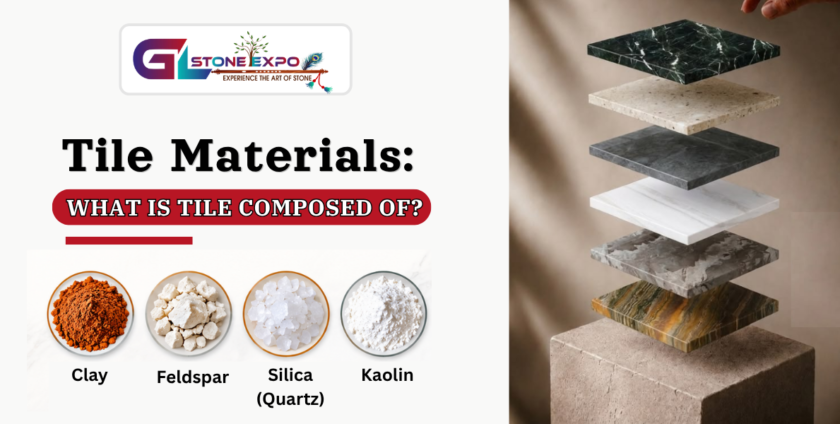
Tile Materials: What is Tile Composed of?
A lot of tiles begin their life cycle from a combination of a few mineral earth materials. Clay, feldspar, and silica (quartz) are pulverized, combined with water, formed and fired at high temperatures. These are the basic processes in creating ceramic, porcelain, and vitrified tiles. We will consider natural stone, cement and glass tiles separately.
So why is this information important? Since the composition of a tile influences how much water the material absorbs, its performance, durability and maintenance. Two tiles that have absolutely the same appearance may have very different features when installed in your bathroom.
This article is about what tiles are composed of, how they are produced, how the major materials differ from one another and which tiles are better for different rooms. The figures used below are general numbers, so do not forget to refer to the data sheet of the particular tile you want to buy.
Quick answers
• Ceramic, porcelain and vitrified tiles are produced from clay, porcelain and silica, all kiln fired.
• Porcelain and good vitrified tiles will all absorb less than 0.5% water. A good quality ceramic will absorb around 3-7%.
• Natural stone comes from rock, cement tiles from the cement to be cured (not fired), glass tiles from glass.
• The less water a tile takes in, the more effective it will be in wet, high traffic areas.
What Are Tiles Made Of?
It varies according to the material. Tiles like ceramic tiles, porcelain and vitrified tiles are made out of clay, feldspar and silica along with kaolin. Stone tiles are cut out of stones quarried out of mines. Tiles like cement tiles and glass tiles are made out of cement and sand and glass respectively.
The process of firing changes soft mass into a tile. As a general principle, a fine mass when fired at high temperature yields a dense tile without pores. It is this density that will be useful to you later, when you are dealing with water, oil and sandal.
What Are the Main Raw Materials Used in Tile Manufacturing?
Four materials do most of the work: clay, feldspar, silica and kaolin. Colouring oxides, binders and glaze go in separately.
| Raw material | What it does in the tile |
| Clay | Makes the mix workable so it holds its shape when pressed. Red or white clay changes the colour of the body. |
| Feldspar | Works as a flux. It melts at a lower temperature than clay or silica, and that glassy melt glues the other particles together as the tile cools. |
| Silica / quartz | The hard skeleton. It stays solid while the feldspar melts around it. |
| Kaolin | A fine clay that burns white. Common in porcelain-type tiles for a cleaner, finer body. |
| Oxides, binders and glaze | Oxides add colour, binders help the pressed shape hold together, and the glaze is a thin glass-like coating that carries the colour and pattern. |
Red body vs white body tiles
These two terms will come up when you visit a tile store. A red body tile is made of red clay, and thus the biscuit (tile underneath the glaze) will appear to be reddish or brown on its side or back. In the case of a white body tile, it will be made of white burning clays, and thus the biscuit will be white. The glaze prevents you from seeing this color on the face of the tile.
How Are Tiles Made From These Materials?
The factory procedure is easier than anticipated.
1. Mix and mill the raw materials such as clay, feldspar and silica to form a fine powder.
2. Shape the powder into tile form.
3. Dry the shaped tiles.
4. Coat the tiles with glaze or any printed pattern that may be required for the tiles.
5. Heat the tiles in a kiln.
6. Surface polishing.
The composition and heat applied during the heating process determine the density and water resistant nature of the final product. Polished tiles go through a milling process following the heat process; hence, it is easy for polished surfaces to show marks compared to non-polished surfaces.
What Are the Different Types of Tile Materials?
Seven materials cover most of what you’ll see: ceramic, porcelain, vitrified, natural stone, cement, terracotta and glass. Each one differs in raw material, firing, porosity and upkeep.
| Material | Made from | Firing | Water absorption |
| Ceramic | Clay-based body | Moderate heat, around 1,000°C | Roughly 3-7% |
| Porcelain | Fine clay (often kaolin), feldspar, quartz, silica | Roughly 1,200-1,300°C | 0.5% or less |
| Vitrified | Clay, quartz, feldspar, silica | Fired until the body turns glassy | Usually 0.5% or less |
| Natural stone | Quarried rock | Not fired | Varies by stone |
| Cement | Cement, sand, pigment | Cured, not fired | Porous |
| Terracotta | Red clay | Lower heat | Porous unless glazed or sealed |
| Glass | Glass | Not applicable | Non-porous |
Ceramic Tiles
Clay tiles fired in low heat. They are good for wall and floor applications. But the problem is that they are porous, which makes them less suitable for wet or heavy traffic floors.
Porcelain Tiles
These tiles are made of finer clays, usually kaolin mixed with feldspar, quartz, and silica. They make excellent floor tiles and can be used both indoors and outdoors but must be kept under cover. Their drawback is that they are dense and hard to cut.
Vitrified Tiles
Clay, quartz, feldspar and silica fired so much that they become glass. These tiles are suitable for flooring, walls and commercial places. Glassy surface is glazed and shiny but can be marked easily and become slippery on wet surface. There are four types of tiles generally available in India.
Natural Stone Tiles
Marble, granite, limestone, slate and sandstone – come from quarries cut into the stone in slabs. Ideal for a distinctive look to floors, walls and stairs. The risk is that every stone reacts differently and may need sealing.
Cement Tiles
These are tiles made of cement, sand, and colorants pressed into molds. They can be used on patterned floors. The only problem is that they are porous.
Terracotta Tiles
Clay that is red in colour and fired at low temperatures. Useful for courtyards and interiors with a rustic look. But their downfall is that they are very porous.
Glass Tiles
Nonporous and easy to clean. Great for walls and back splashes. The problem? These tiles are more used for walls than floors.
If you’d like information about glass tile sizes and uses, click here.
What Are GVT, PGVT, Double Charge and Full Body Vitrified Tiles?
These are the four vitrified types sold in India. They share the same basic raw materials but differ in how the surface and body are built.
| Type | What it is |
| GVT | Glazed vitrified tile. A printed design sits under a glaze layer. |
| PGVT | Polished glazed vitrified tile. Same idea, with a glossy polished finish. |
| Double charge | Two layers pressed together. The top layer carries the pigment and pattern. |
| Full body | Colour runs through the whole thickness, so chips and scratches show less. |
What Is the Difference Between Ceramic, Porcelain and Vitrified Tiles?
Ceramic tiles are fired at lower heat and absorb roughly 3-7% water. Porcelain and vitrified tiles are fired hotter and absorb 0.5% or less.
| Ceramic | Porcelain | Vitrified | |
| Firing | Lower heat | Higher heat | Higher heat, glassy body |
| Water absorption | Roughly 3-7% | 0.5% or less | Usually 0.5% or less |
| Suits | Dry walls | Wet and busy floors | Floors, walls, commercial use |
Here’s where it gets confusing. In India, “vitrified” and “porcelain” are often used for the same thing. Internationally, porcelain is the stricter label, at 0.5% absorption or less. Plenty of good Indian vitrified tiles meet that same figure, so don’t go by the name. Go by the number on the data sheet.
What Do the IS 15622 Water Absorption Groups Mean?
IS 15622 is the Indian standard for pressed ceramic tiles. It sorts tiles into groups by how much water they absorb. The lower the group, the denser the tile.
| Group | Water absorption |
| BIa | 0.5% or less |
| BIb | Above 0.5% up to 3% |
| BIIa | Above 3% up to 6% |
| BIIb | Above 6% up to 10% |
| BIII | Above 10% |
If a salesperson says a tile is “vitrified” or “porcelain”, ask which group it falls in. A tile in group BIa meets the 0.5% or less figure.
How Does Tile Composition Affect Strength and Water Absorption?
It is the composition and firing that determine the porosity of tiles. By porosity, we mean very small air passages within the body of the tile, and through them, water, oil, and dirt get inside. If there is a proper composition with an appropriate amount of melted feldspar, the pores will be closed. So the tile absorbs less water.
However, the strength is not determined by the composition alone. Also take into account thickness and finish of the tile. In case of highly used floors, ask for breaking-strength and abrasion tests as well.
Glazed vs Unglazed Tiles: Does the Surface Change the Material?
It is not the body but it affects the performance of the tile from day-to-day basis. A glazed tile is made up of the coating of glass which provides the color as well as the pattern and makes the surface stain-resistant. The unglazed tiles do not have any coating; thus, the body of the tile can be seen.
Should You Choose Natural Stone or Ceramic Tiles?
Use natural stone if you would like unique patterns, but can cope with maintenance such as sealing some kinds of stones. Select ceramics, porcelain and vitrified materials if uniformity in colours and sizes along with low maintenance are the criteria. For damp and heavily trafficked areas, consider the absorption and slip resistance of all materials before coming to conclusion. If you prefer natural stone, then information about granite will be helpful for you.
Which Tile Material Is Best for Different Areas of a Home?
Which Tile Is Best for a Kitchen?
Porcelain or vitrified floors will be pretty resistant to oil, splashes and the dropped pans. Any glazed ceramic (on the walls and back splashes) is okay; work tops, choose granite or quartz rather than tile.
Which Tile Is Best for a Bathroom?
Bathroom flooring is a low-absorption porcelain or vitrified tile with a textured surface; bathroom walls are glazed ceramic. And, specifically, ask about slip-resistance. Don’t be deceived by the word “anti-skid” that you find on the box – that’s not what you’ll get on a wet floor. Read our guide to tile finishes, and to the most slip-proof bathroom tiles, to learn more.
Which Tile Is Best for the Living Room?
Larger format vitrified or porcelain tiles offer a smooth low maintenance floor. Marble and natural stones offer a high end feel, but require a little more maintenance and some stone may need sealing.
What Are the Best Tiles for the Outdoors?
Choose tiles that are low in absorption with texture that are good for outdoors. It is actually the smooth bathroom tiles that get slippery when it rains. Stone with textures can also be okay depending on the type of stone and how exposed it is.
What Is the Right Tile for Commercial Installations?
For commercial areas that experience lots of traffic, vitrified or highly finished natural stone and porcelain tiles can be used. There is a need for abrasion, durability, and slip resistance test results for the tile you choose.
| Area | Pick this | Look out for |
| Kitchen | Porcelain or vitrified floors, glazed ceramic walls | Oil resistance |
| Bathroom | Textured porcelain or vitrified floors | Slip-resistance data |
| Living room | Large-format vitrified or porcelain | Upkeep vs look (stone) |
| Outdoor | Textured, low-absorption, outdoor-rated | Grip when wet |
| Commercial | Porcelain, vitrified, finished stone | Abrasion and breaking strength |
How Does Upkeep Differ by Tile Material?
| Material | Everyday care |
| Ceramic | Wipe clean and keep the grout sealed. |
| Porcelain | Low effort. Keep grout lines clean. |
| Vitrified | Low effort. Polished faces show marks, so wipe them often. |
| Natural stone | Some stones need sealing. Avoid harsh cleaners. |
| Cement | Needs sealing. |
| Terracotta | Sealing helps. |
| Glass | Wipes easily, but marks show. |
How Can You Tell What a Tile Is Made Of Before You Buy?
Don’t have to guess. Just a few quick tests.
- Check the data sheet: Find the water absorption value and the IS 15622 group. This is the best way to verify.
- Observe at the rear as well as in the edge: The colour of the biscuit is to enable you to know if you will find a purple or white body, full body ceramic tiles display the same colour throughout.
- Test a water drop on the unglazed back: If it penetrates quickly, the tile is porous. If not, its dense.
- A very dense tile sounds sharper: A dull tone hints at more pores in the body.
None of these takes the place of a data sheet but all combined will identify most blatant incompatibilities.
What Are the Common Mistakes People Make When Choosing Tile Material?
- Assuming “vitrified” always means “porcelain”. Check the absorption figure.
- Trusting the “anti-skid” label. Ask for slip-resistance details instead.
- Using polished indoor tiles outdoors. They get slick in the rain.
- Judging a tile by its surface alone. The body underneath decides how it performs.
How Do You Choose the Right Tile Material?
Start from the room and then work back. How wet will it become? What foot traffic will it see? What finish would you prefer?
- Select materials according to the tables given above.
- Find out the water absorption value, IS 15622 group and slip rating.
- Check out the sample under daylight and artificial light.
- Obtain a written quote for tiles, installation, grouting and wastage.
Conclusion
Ceramic, porcelain, and vitrified tiles start from the same raw materials which are clay, feldspar, and silica. The difference between the three lies in their compaction and baking. Density is actually the key point to be considered here – less absorbing tiles in case of moisture and activity, and porous tiles where there is none. Never rely only on labels, ask for the exact values.
If you are interested in having a look at our tiles collection or tiles in Hyderabad, you may visit GL Stone Expo in Kokapet.
Frequently Asked Questions – (FAQs)
1. What are tiles made of?
Ceramic, porcelain, and vitrified tiles are predominantly made up of clay, feldspar, and silica, while natural stone tiles, on the other hand, are made from rocks, cement tiles from cement and sand, and glass tiles from glass.
2. What raw materials are used to manufacture ceramic tiles?
The clay is the starting point, combined with minerals and water. The firing process is done under moderate temperatures. Other additives include feldspar and silica, and usually, a glaze is added on the surface.
3. What is the difference between ceramic and porcelain tiles?
Porcelain is made up of finer clay, usually kaolin, and is baked at a higher temperature, making it more dense and having an absorption rate of less than 0.5%. Ceramic is baked at a lower temperature, and its absorption capacity is between 3-7%.
4. Are vitrified tiles made from natural materials?
These are natural resources – clay, quartz, feldspar, and silica. The tiles are manufactured through processes such as pressing and firing; hence, they are not natural stones..
5. Which tile material absorbs the least water?
Porcelain and good vitrified tiles absorb 0.5% or less, and glass tiles are non-porous. Ceramic absorbs roughly 3-7%, while terracotta and cement tiles are porous unless sealed. Confirm the figure on the tile you buy.
6. Which tile material is best for kitchens and bathrooms?
Low-absorption porcelain or vitrified tiles suit kitchen and bathroom floors, and glazed ceramic works on walls. In wet areas, pick a textured finish and ask for slip-resistance details.
7. Are natural stone tiles better than manufactured tiles?
Neither wins outright. Natural stone gives you one-of-a-kind patterns but varies by stone and may need sealing. Manufactured tiles give more consistent colour and size and simpler care.
8. What is the difference between red body and white body tiles?
Red body tiles use red clay, so the biscuit under the glaze is reddish or brown. White body tiles use white-burning clay, so the biscuit is pale. You can see the difference on the edge or back of the tile.
9. Are glazed tiles made from different materials?
The body is the same kind of material. The glaze is a thin glass-like coating added on top for colour, pattern and surface protection.
Visit our Kokapet showroom or send us an enquiry — our team will help you choose the right stone, finish and size for your space.
Kokapet showroom · Open Mon–Sun, 9 AM – 8 PM


- By: Rajesh" >Rajesh
- Tags: tile materials, tile raw materials, types of tile materials, what are tiles made of
- Category: Blog, Tiles
- 0 comment
Leave a Reply