
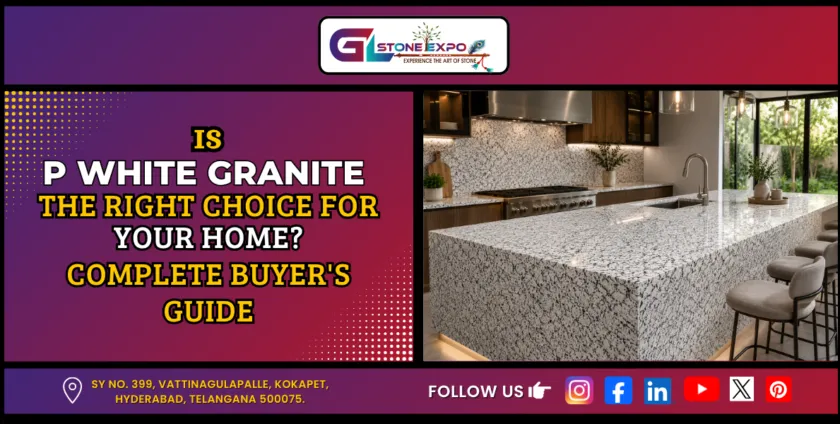
Visit two or three granite showrooms in Hyderabad and P White will probably come up in at least one of them. It gets recommended a lot. What it usually doesn’t get is a proper explanation. You hear “good quality” and “durable” and that’s about it, and then you’re left comparing slabs on your own with no real sense of what you’re looking at.
This guide fills that gap. What the stone actually is, whether it stains or cracks, how much looking after it needs, which finish makes sense for your space, and whether it’s the right fit for your home at all.
P White Granite is a light, off-white stone with grey and black speckling, quarried in Andhra Pradesh. It’s hard-wearing and handles heat well, which makes it a natural fit for kitchens and flooring, but it isn’t something you can install and forget.
Plan on resealing it every 12 to 18 months, and pay attention to which finish goes where — polished indoors, flamed or honed outside. If a bright, reasonably priced natural stone with a small amount of upkeep sounds fine to you, this is a solid choice.
If you’re hoping for something that needs zero attention, or you want a dark and dramatic slab, this probably isn’t it.
What Is P White Granite
It’s a natural stone, quarried in Andhra Pradesh, not something manufactured in a factory. The name itself doesn’t mean much scientifically — “P White” just refers to the quarry lot it came from, which is how the trade names most of these stones. That’s also why you’ll see similarly named stones like S White or Imperial White floating around; different quarry batches, same naming logic.
Geologically, it’s granite through and through. Quartz, feldspar and mica crystals that formed slowly as molten rock cooled underground over a very long time. That slow cooling is the whole reason granite behaves the way it does — the crystals lock together tightly instead of forming in loose layers, which is why it holds up so much better than something like marble against daily wear.
As for the look, expect an off-white to light grey base scattered with grey and black flecks. Some batches lean a bit warmer, with a faint gold or beige tint running through them. Worth keeping in mind before you commit to a slab, because two lots sold under the same “P White” name can genuinely look different sitting next to each other.
P White Granite at a Glance
| Property | Details |
| Type of stone | Natural granite (igneous rock) |
| Origin | Andhra Pradesh, India |
| Colour | Off-white to light grey, with grey and black speckling |
| Hardness | 6 to 6.5 on the Mohs scale |
| Common thickness | 20mm (standard), 30mm (islands, waterfall edges |
| Finish options | Polished, honed, leather, flamed |
| Best indoor use | Kitchen counters, flooring, bathroom vanities |
| Best outdoor use | Balconies, steps, outdoor flooring (flamed or honed only) |
| Sealing frequency | Every 12 to 18 months |
| Heat resistance | Handles brief direct heat; trivet recommended |
| UV / fade resistance | Fully UV-stable, doesn’t fade in sunlight |
| Ideal for | Kitchens, villas, apartments, hotels, restaurants, offices |
Is It Actually Durable
Mostly Yes. Not indestructible, but close enough for daily life if you treat it reasonably.
Cracking: It doesn’t happen often, and when it does, it’s rarely the stone’s fault. Nine times out of ten it traces back to installation — an overhang left without proper support underneath, or a fissure inside the slab that should have been reinforced before cutting but wasn’t.
Staining: This is a real risk only if something like oil, turmeric or wine sits on unsealed stone for hours. Seal the slab properly and this stops being something you need to think about.
Chipping: It tends to happen at the edges, particularly on thinner slabs, if something heavy comes down hard on them. A rounded edge holds up better here than a sharp square one.
Heat: It is rarely an issue in practice. It’ll take a hot pan for a while without complaint. A trivet is still a good habit, mostly to avoid repeated thermal stress on the same spot over years, not because one hot pan is going to damage it.
Sunlight: It isn’t a concern at all. The colour is baked into the minerals, not sprayed on top, so there’s nothing to fade whether it’s on a sunlit kitchen counter or an open balcony.
If there’s one honest takeaway here, it’s this: granite’s reputation for being tough is mostly earned, but most of the horror stories people share about cracked or stained granite come down to a rushed installation or a slab that never got sealed properly. Rarely does the stone let anyone down on its own.
Does It Need Sealing, and How Often
Yes, and this one’s non-negotiable. Seal it at installation, then check it again every 12 to 18 months.
Testing: it yourself is easy enough. Drop a little water on the surface. If it beads up and sits there, you’re fine. If it soaks in and darkens the stone within a couple of minutes, it’s time to reseal.
Kitchen counters: take the most abuse, so check those every six months or so. Flooring and wall cladding can go closer to a year between checks since they’re not dealing with spills the same way a countertop does.
One thing worth asking before you finalise a quote: is sealing actually included? Sometimes it’s quoted as a separate line item and sometimes it’s just skipped altogether, and that’s usually where the “granite stained on me” complaints come from later.
20mm or 30mm — Which Thickness
20mm: It has become the standard for kitchen counters, and there’s a reasonable case for it. It costs less, and with proper support underneath the cabinet, it does everything a 30mm slab does for day-to-day use.
30mm: It gives you a heavier, more premium look along the edge, along with a slight edge in chip resistance, but it costs more and is heavier to work with during installation. It makes the most sense on an island or a waterfall-edge design, where that extra visual weight is actually the point.
For a regular kitchen, go with 20mm on a properly supported base. Save the 30mm for a feature piece if you want one, not the whole layout.
Which Finish Should You Pick
Polished is what most people picture when they think “granite counter” — glossy, reflective, brings the whole colour of the stone forward. The trade-off is it shows fingerprints and watermarks more readily than other finishes.
Honed goes the other way — matte, softer to look at, and it hides smudges much better, which is why it turns up so often on bathroom counters and in more contemporary kitchens.
Leather sits somewhere in between. A bit of texture, a subtle sheen, and it tends to look and feel a little different from slab to slab, which some people like for an island or a feature wall.
Flamed is deliberately rough underfoot. Not something you’d want on a countertop, but exactly what you want on outdoor flooring, steps or a balcony.
Here’s the part that catches people out. Polished P White gets properly slippery once it’s wet, and Hyderabad’s monsoons make that a genuine concern on a balcony or an entrance step, not just a theoretical one. For anything outdoors, stick with flamed or honed. Keep polished for the inside of the house.
Which Edge Profile Makes Sense
There are more options than most people realise — straight, beveled, bullnose, ogee, waterfall — but in practice, it usually comes down to two.
A straight, square edge looks clean and minimal. A bullnose or beveled edge is friendlier around kids and holds up better against knocks. If there are young children in the house, a half-bullnose is often the right compromise — softer than a sharp corner, but it doesn’t lose the clean look entirely.
Where Does It Actually Work Well
Kitchen counters are an easy yes. Heat resistant, tough enough for daily use, and the neutral tone doesn’t fight with whatever cabinet colour you’ve chosen.
Flooring works well too, especially polished, for living rooms and staircases. Switch to honed or flamed near entrances or anywhere water tends to collect.
Bathroom counters are fine, though you’ll want to reseal a little more often given how much moisture they’re exposed to.
Balconies and other outdoor spots need a flamed or honed finish. Skip polished entirely here.
Villas and apartments are where this stone shows up most often around Hyderabad, especially in newer projects, because it gives a premium look without the premium price tag that comes with imported stones.
Hotels, restaurants and offices use it a fair amount too — it holds up under constant foot traffic, and its neutral tone doesn’t clash with branding or interior schemes the way a bolder stone might.
What Pairs Well With It
Cabinets in charcoal grey, navy, matte black or a warm wood tone like walnut or oak all sit nicely against the pale background of the stone, giving you good contrast without trying too hard.
For flooring, both directions work. Light flooring keeps a space feeling open, dark flooring grounds it and adds contrast.
For walls, off-white or warm grey lets the stone stay the focus. If you’d rather the wall lead the design instead, a bolder colour works just as well.
Lighting changes how the stone reads more than people expect. Warm bulbs, around 2700K to 3000K, bring out any gold or beige undertone. Cooler light, 4000K and up, sharpens the grey-white contrast for a brighter, more modern feel. Whatever you’re planning, look at your shortlisted slab under that actual lighting before deciding — showroom lighting alone can be misleading.
Why Every Slab Looks a Little Different
Because it’s a real, quarried stone and not something printed to a pattern, no two slabs are identical. Even slabs cut from the same block can vary a little from one end to the other. That’s not a flaw. That’s just what natural stone is.
If you’re working on something large, like a kitchen island or a feature wall where the pattern needs to line up, ask about book-matching — installing adjacent slabs cut from the same block so the pattern mirrors across the join. It’s not something every supplier offers automatically, so ask, and request the block or lot number for your project while you’re at it.
You’ll also likely come across natural fissures at some point — fine mineral lines that formed as the stone did. Most are purely cosmetic and nothing to worry about. One that runs the full thickness of the slab is a different matter and should be reinforced by the fabricator before cutting, particularly if a sink or hob cutout is going to sit near it.
How to Check a Slab Before You Buy It
Look at it in daylight, not just under showroom spotlights, since lighting can flatter or distort the colour quite a bit. Check that the speckling looks reasonably even across the surface rather than bunched up in one section. Run a hand over it.
It should feel smooth, not pitted or rough in patches. Look closely at the corners and edges for hairline cracks, since that’s usually where damage from transport shows up first. Ask for the block or lot number so you have the option to request matching slabs later.
Insist on seeing the actual slab you’ll be getting, not just a small sample chip, since a chip won’t tell you anything about the pattern variation across a full piece. Measure the thickness yourself rather than taking the quote’s word for it. And ask when it was last sealed, particularly if it’s been sitting around in a yard for a while.
Questions worth putting to your supplier directly:
- Which quarry or lot is this slab from?
- Can I see the actual slab before it gets cut?
- Is sealing included in the price, or billed separately?
- What happens if a fissure shows up once cutting starts?
- Can slabs be book-matched for my project?
- What’s the workmanship warranty on the installation itself?
Common Mistakes People Make
Picking a slab based on a tiny sample chip rather than the real thing. Not accounting for how showroom lighting is quietly changing how the stone looks. Skipping sealing entirely because “granite doesn’t need maintenance.” Putting a polished finish somewhere outdoors and turning it into a slip hazard the first time it rains.
Ordering multiple slabs without asking for a matching lot number, then being surprised when they don’t quite line up. Going with the cheapest quote on the table without asking why it’s cheaper — sometimes that’s a lower-grade cut from near the edge of the block. And leaving an island overhang without proper support underneath, which is probably the single most common cause of a granite counter cracking.
Keeping It Looking Good
Wipe it down daily with a soft cloth, a bit of mild dish soap and warm water. Skip vinegar, bleach or anything ammonia-based — they break down the sealant faster than most people realise.
Run the water-drop test every 6 to 12 months and reseal when it fails.
Use a trivet under hot pans and a cutting board when you’re chopping. This has less to do with protecting the stone and more to do with keeping your knives sharp and avoiding repeated heat stress in one spot. Wipe up oil, turmeric or wine spills sooner rather than later, and staining just won’t be something you deal with.
So — Is It Right for Your Home?
It’s probably a good fit if you want a bright, neutral stone without paying import prices, you need something durable enough for daily kitchen use or busy flooring, you’re working to a set budget but still want real stone rather than a laminate look, you don’t mind resealing roughly once a year, and you’re based in or around Hyderabad where sourcing and matching this stone is straightforward.
It’s probably not the right fit if you’re after a surface that asks nothing of you, ever, you want a dark, dramatic, high-contrast slab as a centrepiece, your whole project is outdoors and you’re set on a polished look regardless, or you need every single slab to look identical, which natural stone simply won’t give you.
What People Usually Ask About P White Granite
| Question | Short answer |
| Is P White Granite good for kitchen counters? | Yes, heat resistant, durable, and pairs with most cabinet colours. |
| Does P White Granite stain easily? | Only if left unsealed; sealed properly, staining is rare |
| Can I put hot pans directly on it? | It can handle brief heat, but a trivet is still worth using. |
| 20mm or 30mm — which is better? | 20mm for standard counters with good support; 30mm for islands or a heavier look. |
| Can P White Granite be used outdoors? | Yes, but only in flamed or honed finish — polished gets slippery when wet. |
| Does every slab look the same? | No, natural stone varies — ask for matching lot numbers on multi-slab projects. |
| What is book-matching? | Installing adjacent slabs from the same block so the pattern mirrors across the join. |
| Are fissures in the stone a defect? | Usually not — cosmetic fissures are normal; full-thickness ones need reinforcing. |
| Is it okay for bathroom counters? | Yes, just reseal a little more often given the extra moisture. |
| Can a chipped edge be fixed? | Small chips can be filled and re-polished; bigger ones may need a slab replacement. |
| How long does P White Granite last? | Decades, with regular sealing and basic care. |
| Does it fade in sunlight? | No — the colour comes from the minerals, not a coating. |
| Is it suitable for hotels or restaurants? | Yes — it holds up well under heavy foot traffic. |
| What edge is safest for homes with kids? | A half-bullnose or beveled edge, softer than a sharp square corner. |
| Does it work with underfloor heating? | Yes, granite conducts heat well and suits underfloor heating. |
| Is it a budget-friendly option? | Yes, compared to imported white granites, since it’s quarried locally. |
Conclusion
P White Granite has earned its spot as one of Hyderabad’s go-to stones for fairly simple reasons — it looks good, holds up to daily life, and doesn’t come with an import price tag attached. It won’t suit everyone; skip it if you want something that needs zero attention or a bold, dark slab as a centrepiece. But for most kitchens, floors and homes, it does exactly what it’s supposed to.
Most of the regret people end up feeling about this stone has nothing to do with the stone. It’s skipping the sealing, using the wrong finish in the wrong place, or not checking the lot number before ordering multiple slabs. Sort those three things out and it’s a stone that’ll look good for years without asking much of you in return.
Want to see actual slabs before deciding? Visit the GL Stone Expo showroom in Kokapet, Hyderabad, or get in touch for current pricing and availability.
Frequently Asked Question – (FAQs)
1. What is P White Granite?
A natural stone quarried in Andhra Pradesh, India — off-white with grey and black speckling. Real granite, not an engineered or composite material.
2. Is P White Granite durable — will it crack or stain?
Yes, generally. Cracking is uncommon and usually points back to a poor installation rather than the stone itself. Staining happens mainly when oil, turmeric or acidic spills are left sitting on unsealed stone for hours.
3. Does P White Granite need sealing?
Yes — once at installation, then again roughly every 12 to 18 months. A quick water-drop test tells you when it’s due: beads up, you’re fine; soaks in, reseal.
4. Which finish is best for P White Granite?
Polished for indoor counters and flooring, since it brings out the brightness. Flamed or honed for balconies and outdoor areas, since polished turns slippery once it’s wet.
5. Is P White Granite the right choice for your home?
For most kitchens and homes, yes — durable, reasonably priced, and easy to source around Hyderabad. Less of a fit if you want zero maintenance or a dark, dramatic slab, since it’s a light stone that still asks for basic upkeep.
Visit our Kokapet showroom or send us an enquiry — our team will help you choose the right stone, finish and size for your space.
Kokapet showroom · Open Mon–Sun, 9 AM – 8 PM


Leave a Reply