
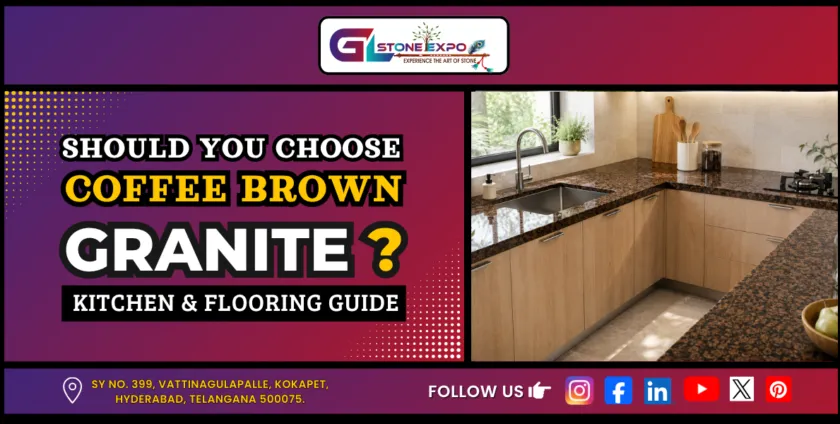
Should You Choose Coffee Brown Granite? Kitchen & Flooring Guide
If you want a dark stone, that has warmth and a strong character for your kitchen counter or floor, then add Coffee Brown Granite to your shortlist. It doesn’t get much better in terms of originality, and like all natural stones it will have variations between slabs.
In effect, it’s a trade off for a natural material, because when it comes to the floor the only variations you can be sure of are between stones, so don’t expect two stones looking identically, you should be prepared for some visual variety if you decide it’s coffee brown granite worktop for you.
Here’s a breakdown of what this coffee brown granite is, where it can be used, where it can’t be used, what it can cost you, and some question that get put on us just before purchase.
What Is Coffee Brown Granite, Really?
A natural granite quarried mainly in India, this is mainly composed of a dark brown to nearly black body with flecks of minerals that could be tan through to charcoal according to the individual block sourced. The cause of these coloured minerals is down to iron bearing biotite which has been crystallizing through the body of the granite over the millions of years.
It was beneath the earth and is the cause of each block looking entirely different from one end of the block to the other. One corner might be a near-solid coffee brown, and the other end could carry heavy black veining. That’s not a defect—it’s just what a stone that came out of the ground looks like, and it’s worth knowing before you fall for one sample chip.
Does It Work in a Kitchen?
Yes, it is ideal for the majority of Indian kitchens. It can stand the rigorous daily wear, withstand heat more effectively than laminate or less durable stones and, more crucially for busy hands, its dark hue conceals everyday crumbs and grease spatters better than its lighter colored counter parts. It is not impervious, however; it can be chipped when a heavy cast iron skillet is dropped onto it from a certain height.
Leave turmeric or oil sitting on it overnight and you might get a mark, because it’s not fully stain-proof underneath the sealant. Basic habits go a long way here — a trivet under anything straight off the flame, a quick wipe when something spills, and you’re fine.
If your kitchen already runs small or dim, pairing it with lighter cabinets keeps the granite as the standout feature instead of making the room feel closed in.
What About Flooring?
Flooring is honestly where this stone feels most at home. You’ll see it in hallways, living rooms, entryways, staircases, even office lobbies, because it takes heavy foot traffic without much fuss and the dark tone doesn’t show every bit of dust the way pale flooring does. What actually matters for a floor isn’t the colour, though — it’s the finish.
A polished surface looks great but gets slick when wet, so anywhere water shows up regularly entrances, bathrooms is better served by a honed or flamed finish that trades a bit of shine for grip.
The Finishes, Side by Side
| Finish | Look | Works Best For | Downside |
| Polished | Glossy, richest colour | Kitchen counters, formal rooms | Slippery when wet, shows fingerprints |
| Honed | Matte, soft | Bathrooms, busy floors | Etches a little more visibly over time |
| Leathered | Lightly textured | Modern kitchens, feature walls | Collects fine dust in the texture |
| Flamed / Textured | Rough, grippy | Outdoor steps, pool edges | Tough to keep spotless, less formal look |
What’s It Going to Cost You?
There’s no single number for this — thickness, finish, slab quality, cutting, transport and fitting all stack on top of the raw material cost, so “the same stone” can come out at very different final prices from two different suppliers.
As a rough indicator, some current Hyderabad listings show a thinner, standard polished slab around ₹120 per sq ft, and a 20mm polished one closer to ₹150. Take those as ballpark figures, not gospel — always ask for the total installed cost before comparing two quotes, because comparing raw material rates alone tells you almost nothing.
How Does It Compare to Other Popular Granites?
This can get confusing, but this summary should help.
Coffee Brown Vs Tan Brown
Tan Brown contains more of a red tint and a higher percentage of speckling than coffee brown and has more prominent speckling. There isn’t a “winner,” and it is purely a pattern preference on both a visual level.
Coffee Brown Vs Black Galaxy
This is more uniform black galaxy with a smaller amount of gold speckling than coffee brown and appears to have more of a formal and dramatic effect than coffee brown. Coffee Brown appears more understated and would integrate well with wood cabinetry and other traditional styles.
Coffee Brown Vs Steel Gray
Steel Grey is a cool-toned stone, whereas Coffee Brown is a warm-toned stone. If your cabinets and/or flooring are a warmer tone of cream, beige or wood, coffee brown is generally a better match.
Is It Fine for Vastu-Focused Homes?
This question comes up a lot, so let’s address it head-on: granite as a material, including Coffee Brown, is generally treated as Vastu-neutral. It’s the placement that carries the weight in Vastu. where the kitchen platform sits, which direction the stove and sink face, where a flooring transition happens not the specific colour of the stone.
If Vastu matters to your household, it’s worth running the layout past your architect or Vastu consultant instead of assuming the colour itself is an issue.
Where Else People Use It
Kitchens and floors get most of the attention, but this stone shows up in a few other places too. Bathroom vanities are a common one, since it handles daily splashes and moisture fine once it’s properly sealed. Staircases benefit from its hardness—treads take a beating every single day, and this stone shrugs that off better than most alternatives.
It also works as a feature wall, where the mineral pattern reads almost like a painting once you see it at a larger scale. Some homeowners take it outdoors too — porches, garden paths, pool edges — as long as the finish is right for the exposure.
And you’ll spot it a lot in commercial lobbies and reception counters, mostly because a natural stone tends to look a notch above engineered alternatives at a similar price.
Pros and Cons
| What’s Good | What to Watch For |
| Real durability, built for daily use | Heavy — needs proper support during fitting |
| Warm colour that pairs well with wood and light cabinets | Pattern varies slab to slab, no exact colour match |
| Handles heat better than most kitchen surfaces | Not fully stain-proof, needs sealing now and then |
| Dark tone hides everyday marks and dust | Can still chip or crack under a hard, sharp hit |
| Comes in a few finish options for different needs | Fixing damage needs a professional, not a DIY job |
| Lasts for decades with basic care | Polished finish gets slippery on wet floors |
Keeping It Looking Good
Day-to-day care isn’t complicated — a soft cloth, warm water and a mild stone cleaner handle most of it. Wipe up spills reasonably quickly rather than letting them sit overnight and you’ll avoid nearly every staining headache people run into.
Skip harsh, acidic cleaners like vinegar or lemon-based sprays, and skip anything abrasive too, since both wear down the sealant and eventually the finish underneath. As for sealing, there’s no fixed once-a-year rule that applies to every slab. it depends on how porous your particular stone is and which finish you chose.
A quick way to check: splash a bit of water on the surface. If it beads up rather than soaking in within a few minutes, the seal’s still doing its job. If it darkens the stone fast, it’s time to reseal.
Before You Sign Off on a Slab
Ask to see the actual slab that’ll be used for your project, not a small sample chip, because that tells you almost nothing about the real pattern you’ll be living with. Walk the length of it, check for consistency, and look closely at the edges and corners for hairline cracks or old repair work.
Get the thickness and finish confirmed in writing so nothing shifts once cutting starts. Check the slab dimensions against your layout so you’re not stuck with an unplanned seam, ask whether sealing is included in the quote, and get the full installed price material, cutting, edge work, transport, fitting, everything before you agree to anything. Our step-by-step guide to choosing the best granite slabs in Hyderabad covers this in more depth if you want the fuller checklist.
Conclusion
Coffee Brown Granite has earned its place in Indian homes the old-fashioned way — by actually holding up over years of daily use, not through marketing.
It gives you real character and durability, as long as you go in accepting that natural variation and a bit of upkeep come with the territory.
If the warm brown-and-black look appeals to you and you’re willing to look at the real slab before you buy, it’s a genuinely solid pick for a kitchen counter or a floor that has to deal with actual daily life. You can browse the full granite collection or get in touch for a slab viewing at the Kokapet showroom.
Frequently Asked Questions (FAQs)
Is Coffee Brown Granite good for kitchen countertops?
Yes, it handles daily cooking wear well and its dark tone hides everyday marks. It’s not stain- or scratch-proof, though, so basic habits like wiping spills and using a trivet still matter.
Is it good for flooring too?
Yes—hallways, living rooms, entrances, stairs, and commercial spaces all work fine. Just skip the high-polish finish for anywhere water shows up often; honed or textured grips are better.
What does it cost per sq ft?
There’s no fixed number. It depends on thickness, finish, and whether fitting and fabrication are included, so always ask for the full installed price rather than comparing raw material rates.
How’s it different from Tan Brown Granite?
Tan Brown carries a more reddish-brown tone with heavier speckling, while Coffee Brown sits deeper and more even. It really comes down to which pattern you personally like.
Does it need sealing?
Usually, yes, but how often depends on the slab and finish. A quick water-bead test tells you whether your current seal is still holding there is no need to guess on a fixed yearly schedule.
Is it okay for a Vastu-conscious home?
The stone itself is treated as Vastu-neutral. What actually matters is where the kitchen platform, stove and sink sit worth confirming with a Vastu consultant if that’s a priority.
Can it chip or crack?
Yes, though it takes a fairly hard hit. Minor chips and hairline cracks can usually be filled and polished back to nearly invisible by someone who knows what they’re doing.
Which cabinet colours suit it best?
White, cream and beige give strong contrast, while natural wood leans warmer and more traditional. Both are safe, well-tested combinations.
How do I know a slab is real and not dyed?
A genuine slab shows natural, uneven variation rather than a pattern that repeats perfectly, and it feels cool and dense to the touch. Ask the supplier where it’s quarried from, and look at it in daylight before deciding.
What should I check before I buy?
See the actual slab, not just a sample. Check the pattern, look for cracks near the edges, confirm thickness and finish in writing, and get the complete installed cost before you approve anything.
Visit our Kokapet showroom or send us an enquiry — our team will help you choose the right stone, finish and size for your space.
Kokapet showroom · Open Mon–Sun, 9 AM – 8 PM


Leave a Reply