
Is Black Galaxy Granite Worth Buying? Complete Home Buyer’s Guide (2026)
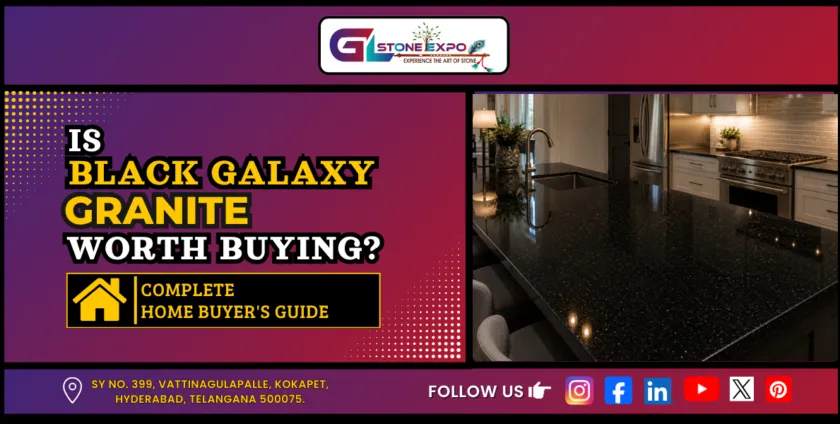
Most of you have probably already seen this. It’s a big black rock with little tiny spots of black and silver sprinkled all across it as if someone was shooting stars into it. This rock is black galaxy granite, and yes, it does look impressive in the picture.
But how do you make sure that the picture reflects your kitchen?
Is this going to withstand your kitchen activities, or is it going to look wine stained from your first encounter, and are the prices you are being told truly appropriate for what you are about to receive? Follow this closely as if I was you friend that was experienced in purchasing about a dozen slabs of granite before purchasing my own countertop:
So What Exactly Is This Stone?
Black Galaxy Granite is a natural stone, not something made in a factory. It forms deep underground, where hot molten rock cools down over an incredibly long time and slowly turns solid. That slow cooling is actually why it looks the way it does — it gives the crystals inside time to grow and settle into that dark, dense pattern.
Those gold and silver flakes don’t have any paint or stain on them, these are actual crystal minerals, predominantly feldspar or biotite, caught within the black rock in the cooling stages of the rocks formation. Due to nature not operating like a printing press no two pieces will ever be exactly the same. One will have small tight speckles, another with much larger wider specks with justLoads of glitter, never sure till you actually get to the piece.
This stone has strong ties to Andhra Pradesh, an Indian state that sources dark granite. However, the suppliers and methods don’t work the same everywhere so never just assume every vendor cuts the stone from the same quarry.
People use it everywhere in a home — kitchen counters, islands, bathroom vanities, floors, staircases, even accent walls. It’s stayed popular for years, mainly because nothing engineered really copies that natural shimmer.
The Basics, At a Glance
| Detail | Information |
| Stone type | Natural granite (igneous rock) |
| Look | Deep black with gold and silver flecks |
| Common finishes | Polished, honed, leathered |
| Common thickness | 15mm to 20mm slabs, varies by supplier |
| Best uses | Countertops, flooring, staircases, vanity tops, cladding |
| Upkeep | Reseal about once a year |
| Biggest buying tip | See the real slab and get the grade in writing |
Every Buyer Actually Asks
Will it hold up in my kitchen?
Pretty much every homeowner asks this, and the honest answer is yes. Granite is naturally hard, so it shrugs off the everyday stuff — knife slips, dragged pots, kids leaning on the counter. It handles heat well too. You can rest a warm pan on it without much worry.
But here’s the catch nobody mentions: “heat resistant” doesn’t mean bulletproof. Yanking a pan straight off a hot stove and dropping it on a cold section of stone still isn’t great long-term. A trivet costs a few rupees and saves you the headache. It’s an easy habit to build.
Is it going to stain the moment I spill something?
Not if sealed properly. Granite has very small microscopic pores through which liquid can eventually leak if the surface is left unprotected. Sealant fills these so oil, coffee, wine, etc, is held at the surface.
Here is a neat trick that is helpful to know! Pour several drops of water on the counter. If they bead up like on a waxed car then your seal is OK. If they seep into the stone and darken it in a minute or two, it needs resealing. It takes 2 minutes to do this, and it tells you all that you need to know.
Why does the price change so much from shop to shop?
This trips up almost every first-time buyer, so it’s worth slowing down here. The number you’re quoted usually isn’t just “the stone.” It’s the slab cost, plus cutting and shaping, plus edge work, plus any cutouts for a sink or cooktop, plus polishing, plus transport, and sometimes installation labor too.
So when two suppliers quote wildly different prices for what looks like the same slab, it’s often because one included installation and the other didn’t. Or one is quoting a lower grade dressed up to look premium. Ask for a line-by-line quote. It sounds fussy, but it saves you real money.
How do I actually tell if a slab is good?
Start by looking at the black background itself. A good slab has a deep, even black tone all the way across. If you spot grey patches or a washed-out, uneven color, that’s usually a lower grade wearing a higher price tag.
Then look at the flecks. On a solid slab, they’re spread fairly evenly, not bunched up in one corner with bare patches everywhere else. Bigger flecks aren’t automatically better, by the way — that’s just a style choice. Small, tight flecks give a subtle shimmer; large ones make more of a statement.
Last thing, run your palm across the surface. A little natural texture is completely normal for real stone. But if it feels rough or pitted in a lot of spots, that usually means extra resin filler was needed during processing, which isn’t a great sign.
Grades, Explained Without the Jargon
Suppliers generally sell this stone in three grades. Knowing the difference stops you from paying premium money for something that isn’t premium.
| Grade | What You’re Really Getting | Good For |
| Commercial Grade | More visible marks, flecking looks uneven | Budget jobs, floors, spots nobody stares at |
| Standard Grade | Cleaner look, balanced flecking | Most kitchens and bathrooms |
| Premium / Star Galaxy | Rich, dense flecks, very even tone | Islands, feature walls, anything meant to impress |
One thing worth doing: Get the grade written on your quotation, not just spoken to you across a counter. If the delivered slab doesn’t match what you were shown, that piece of paper is your proof.
Before You Say Yes to a Slab
Don’t approve a big order based on a tiny sample chip. A 6-inch piece can look nothing like the full slab once it’s covering ten feet of countertop — the pattern spreads and repeats differently at that size. Ask to see the actual full slab you’ll be getting, not something “similar” from a catalog photo.
Lighting plays tricks too. This stone can look completely different under daylight versus warm kitchen bulbs versus bright showroom lighting. Something that dazzles you under showroom lights might feel flatter once it’s sitting in your own kitchen. If you can, check it near a window, or even take a small piece home overnight before you commit.
Also ask how the fabricator plans to cut it for your specific layout. Where the seams land, how the pattern lines up across joins, how corners get finished — all of that matters just as much as the stone itself. A gorgeous slab can still look off if the cutting job is rushed.
Where It Actually Works Best in a Home
| Area | Why It Fits |
| Kitchen countertop | Takes daily abuse well; looks great against white or cream cabinets |
| Kitchen island | Becomes the room’s centerpiece almost instantly |
| Bathroom vanity | Sees far less wear than a kitchen counter, so it stays looking newer longer |
| Flooring and stairs | Tough enough for years of heavy footsteps |
| Accent wall | Turns one wall into a genuine feature |
The finish matters more than people expect. Polished is a glossy finish and will make any flecks on the granite really “pop”, hence why it is perfect for countertops. Honed – This is a smooth, low-lustre, matte finish. It offers a more subtle, subdued look if you prefer something a little less intense. Leather – this will have a bit of a textured feel to it, that also has the benefit of somewhat masking day to day scuffs.
Black Galaxy vs Absolute Black vs Quartz
| Feature | Black Galaxy Granite | Absolute Black Granite | Quartz |
| Look | Black with gold and silver flecks | Plain, solid black | Man-made, repeats every time |
| Uniqueness | Every slab is genuinely one-off | Fairly consistent | Identical batch to batch |
| Sealing | About once a year | About once a year | Rarely needed |
| Heat handling | Strong, just skip sudden extremes | Strong, same rule applies | Good, but can scorch under very high heat |
| Best if you want | A bold, natural, one-of-a-kind look | Clean, minimal, uniform black | Nothing to maintain |
If zero maintenance is your only priority, quartz wins, plain and simple. But if you want something that looks genuinely different from every other kitchen you’ve seen, and a once-a-year reseal doesn’t bother you, this stone is hard to beat.
Keeping It Looking Good For Years
Day to day, it’s low effort. Wipe spills with warm water and a soft cloth, and give it a proper clean with a pH-neutral stone cleaner once a week. Skip the bleach and the harsh acidic sprays — they wear down the polish and weaken the seal faster than normal use ever would.
Reseal roughly once a year, or sooner if that water-droplet test tells you the seal’s worn off. If something does stain, don’t wipe it — blot it. Wiping just spreads the liquid further into the stone. For a stubborn mark, a granite-safe poultice cleaner left on overnight will usually pull it right out.
Mistakes People Keep Making
- Saying yes based on a tiny sample instead of the actual slab
- Not getting the grade in writing
- Forgetting to ask how cutouts change the final bill
- Not asking about edge style, which quietly affects both look and price
- Never asking where the seams will fall
- Only checking the slab under one type of light
- Not asking how often that specific slab will need resealing
Conclusion
Honestly, for most homeowners, yes. It’s tough, handles heat and scratches well, and gives your home a look that nothing engineered really matches. That one small yearly sealing job is a fair trade for a countertop this striking.
It works best for people willing to spend a few extra minutes upfront — checking the real slab, getting the grade in writing, asking where the seams will go, and understanding exactly what’s in the quote. Skip that, and you risk paying premium money for a slab that isn’t premium at all.
| Want to see real slabs before you decide? That’s really the whole point of this guide. GL Stone Expo sells genuine Black Galaxy Granite slabs and tiles for kitchens, floors, and staircases. We’ll show you the actual piece before you pay, put the grade in writing, and give you one honest price — not five confusing ones. Call GL Stone Expo: +91 95158 11818 Drop by the showroom, or just ask for a quote on the exact slab you’re considering. |
Frequently Asked Question – (FAQs)
Is it good for kitchen countertops?
Yes. It handles scratches and everyday heat well, though it still needs a yearly reseal to stay stain-resistant.
How often does it need sealing?
About once a year for most kitchens. The water-droplet test tells you if it needs it sooner.
How do I spot a good slab before buying?
Look for a deep, even black background and evenly spread flecks, and always ask to see the real slab, not a sample chip.
Is it better than quartz?
It looks more natural and unique. Quartz needs almost no upkeep. Pick based on which one matters more to you.
Why do prices vary so much?
Grade, thickness, finish, fabrication, and whether installation is included all change the total. Always ask for a line-by-line quote.
Visit our Kokapet showroom or send us an enquiry — our team will help you choose the right stone, finish and size for your space.
Kokapet showroom · Open Mon–Sun, 9 AM – 8 PM


- By: Rajesh" >Rajesh
- Tags: Black Galaxy Granite, Black Galaxy Granite India, black granite, granite, Granite Countertop, Granite Design, Granite Flooring, Granite Hyderabad, Granite Maintenance, Granite Price, Granite Slabs, Home Buyers Guide, Home Interiors, Hyderabad Granite, Kitchen Design, Kitchen Granite, Natural Stone, Stone Slabs
- Category: granite
- 0 comment
Leave a Reply