
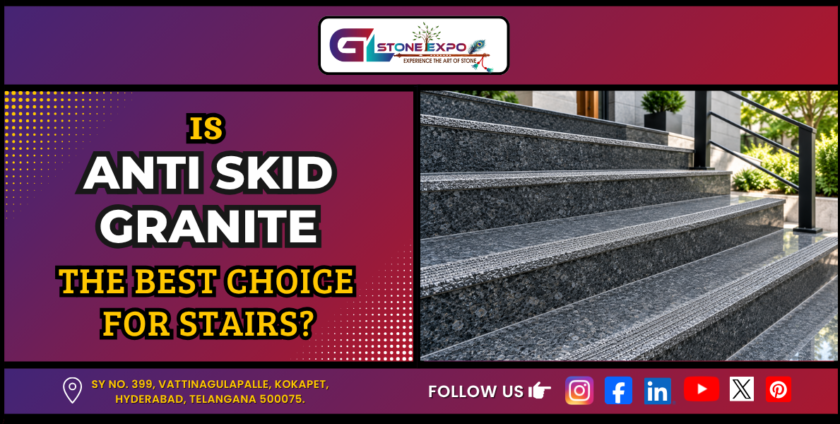
Is Anti Skid Granite Suitable for Staircases?
People choose a material for the staircase based on strength and aesthetics first and only then think about grip, usually after an almost-fall. Granite has a lot going for it in terms of the former and the latter in case of the right finish.
This article describes various granite finishes and where each of them is applicable; how granite compares to marble and tiles and what you should check before paying the money.
What Does Anti Skid Granite Mean?
There are various finishes that can be applied to a single piece of granite stone. When polished, it will have a shiny look like those found in showrooms and in hotel lobbies. If honed, it will lose its shine and become a matte finished surface. The flame finishing process will involve treating the surface with high heat and peeling off the top layers of the stone creating a rough surface. The leather finish will create a soft and slightly wavy texture that people tend to appreciate.
The leather and flamed finishes are the two most common anti-skid granite finishes although in this case the traction will be determined by how deep the finish was made on the stone. Honed granite will be the middle of the road; calming to the eye although it may be much smoother than it seems. Polished granite needs protection where there could be water present.
Anti-skid and non-slip should be taken to mean an intention and not a guarantee.
Which Granite Finish Is Best for Stairs?
The table below is a starting point, not a verdict.
| Finish | Best suited to | What to check |
| Flamed | Outdoor steps, exposed staircases | Texture depth and wet-condition grip |
| Leathered | Indoor or covered outdoor stairs | Varies by supplier and processing |
| Honed | Dry indoor staircases | A matte look does not guarantee grip |
| Polished | Dry, low-risk indoor areas | Can be slippery when wet; assess carefully for stairs |
A veranda with a cover during a dry afternoon and a terrace without a cover during the peak of the rainy season are completely opposite environments for the same stone; hence, you should be looking at the worst-case scenarios, not the average, regarding the condition in which the steps will be exposed to. Whenever there is a choice between two finishes that perform the same, opt for the more rugged finish.
Is Anti Skid Granite Good for Inside Stairs?
For the most part, yes. Leathers and honed granites with proven skid resistance will work fine for most inside staircases, whereas polished granite needs to be approached with more caution.
The assumption that the inside stairs remain dry can easily be made, yet it’s often far from reality. The stairs near the main entrance are constantly exposed to water from umbrellas and wet shoes, those situated near a balcony are hit by rain carried inside, and those near the bathroom get damp feet.
It’s common practice in India to walk barefoot or in socks on the inside stairs, which provide much less friction than rubber-soled shoes. A tread that felt perfectly safe to you at the showroom in your shoes can suddenly feel differently at home.
If there are any small kids or elderly relatives living in the house, go for the textured surface despite how cautious you are about slippers. Don’t use too many floor polishes and waxes – they look like an innocent finishing touch but add a slippery layer to the tread gradually.
Related reading: Which Is Best Granite Flooring Design for Home in Hyderabad?
Is Anti Skid Granite Right for Outdoor Staircases?
Yes, if the finish is rough enough and the staircase is designed to drain rainwater. Both aspects are equally important. No matter how good the texture is, if the water remains on the stairs, it will not be useful.
It’s useful to see outdoor staircases as a mini-system. The finish gives the traction. The small slope of each step makes the water drain from them. Cleaning removes the dust and green layer of algae, which form after raining.
Also, the clearly visible line at the end of each step, which can be either the nosing or the contrasting strip. The lack of just one aspect means more load for the other three. If you neglect cleaning for several years, even the rough texture becomes slippery.
Related reading: Exploring Granite Finishes – Polished, Flamed, and More
Is It Possible To Make The Polished Granite Staircase Slip-Resistant?
Sometimes. There are ways, but the success depends on both the material used and the technique employed. No one can guarantee any result. In case polishing of granite is not negotiable, for instance, for the lobby staircase, there are three common options.
Surface treatment may make the gloss slightly irregular. But it also may decrease the shine level and modify the appearance of color. Grooves carved into the tread near its edge provide additional friction for the shoe sole. Inserts installed in the nosing can be selected matching the color of the stone or contrasting to it.
Ask about the particular treatment applied to the surface, its impact on the appearance and durability during the year of constant use. See the treated surface on the test specimen and in the wet state.
Frankly speaking, if the anti-slip quality is your primary concern and polishing secondary, it is much easier to apply flame or leather texture initially than to treat polished granite later.
Do Granite Stairs Require Nose Guards or Grooving Along Edges?
Yes, in almost all situations. The edge of the step represents the last contact point of the foot and a place where accidents happen.
Texture on treads can prevent slip, but it cannot serve to indicate that the end of the tread is reached. Edge provides that information, and grooved or textured nosing increases friction at that very point, while another strip in a contrasting color allows one to easily find the edge in dim light or in case of poor eyesight.
Consistency in sizes of treads and risers is equally important – if all are the same, but only one differs, it will be that step which will become dangerous. Even small chips require repairs as soon as possible as they represent both danger and wear.
For further information about sizes and edges, see building requirements in your area.
Comparison of Granite and Marble on Staircases
When it comes to staircases that get lots of traffic, granite is always the more practical choice. This is because it’s harder and can handle stains as well as daily wear better than softer stones like marble. The beauty of marble lies in its veining and timeless elegance. The cost of this choice is that marble needs regular maintenance, and some types react to acidic substances.
| Feature | Anti-skid granite | Marble |
| Durability | Generally well suited to heavy foot traffic | Varies by stone; needs more care |
| Slip resistance | Depends on finish | Depends on finish |
| Appearance | Natural patterns, wide colour range | Distinctive veining, classic look |
| Maintenance | Straightforward with a suitable cleaner | More sensitive to acids and stains |
| Outdoor use | Suitable varieties and finishes available | Depends on the specific stone |
A matte finish doesn’t necessarily mean that either stone is safe. Think about what the finish is really like and how it behaves when it’s wet.
Related reading: Granite vs Other Stones: Most Durable Choice for Homes | Nano White vs Italian Marble Comparison Guide
How Does Anti Skid Granite Compare With Anti-Skid Tiles for Stairs?
Granite is the tougher and more durable material of the two. Tiles are usually less expensive and available in a variety of styles, which even imitate stones. Both are able to provide good traction if the surface is proper, so the only thing that should be considered here is cost and durability.
| Feature | Anti-skid granite | Anti-skid tiles |
| Material | Natural stone; every slab is unique | Manufactured; patterns are consistent |
| Appearance | Natural grain and colour variation | Wide range of designs, including stone looks |
| Cost | Varies; often higher than tiles | Varies; often lower than natural stone |
| Grip | Depends on the finish | Depends on the surface texture and rating of the product |
| Edges | Edge profiles can be cut into the stone | May need separate edge trims or profiles |
Where everyone who enters uses the staircase, or where there is high traffic on the stairs, there is no harm in spending a little extra money to install granite. It is also true that a short staircase which does not see much traffic and is on a tight budget can be handled very well by using an anti-slip tile.
Related reading: Complete Guide to Types of Tiles
How Do You Maintain Granite Stairs?
Good grip is a clean, unblemished surface – so most of what we do is just business as usual.
- Sweep regularly, because grit and dust on the treads reduces traction.
- Use a pH-neutral stone cleaner. Basing on the directions, do not use chemical with ammonium or acids.
- Quickly mop up spills; if the water is running into the same spot, then find out why.
- Look for moss and algae growth on outside steps (more after rainy season).
- Look around joints and edges for loose slabs, chips or uneven steps.
- Avoid leaving any waxy or shiny finish on the treads.
Sealing will not make granite less slippery although it can be used to prevent stains, some sealers may alter the surface feel; verify the feel of a test patch before sealing your finish. If steps are still slippery after a deep clean, call the installer or fabricator for an opinion.
What to Consider When Choosing Granite for Your Staircase
- Below are a few considerations you should do before you make your decision:
- Find out what finish the stone has, if any. For example, is it flamed or leathered? Or is it honed or polished?
- Request slip-resistance testing information when possible, so you’re not just relying on “anti-slip.”
- Inquire your installer how thick the granite is. It depends upon the support, fixation and structure.
- Before you take the slabs check out with cracks, chips and even finishing.
- Ensure your treads, risers and nosings are going to be levelled and quality assured.
- Give a thought to the entire cost of the task. It includes cutting, side edge polishing, transportation and setting up.
- Request a sample and view it in the lighting you will be installing it in. Feel the stone, and with the suppliers permission, try wetting it and applying shoe sole to it. The photos will not show the texture.
Related reading: How to Identify Genuine High Quality Granite | How to Choose the Best Granite Slabs in Hyderabad
What Mistakes Should You Avoid When Choosing Granite for Stairs?
Most of the problems you may have with the granite staircase start at the time of decision, in the showroom, not necessarily a problem with the granite itself.
The conventional choice: finish and glaze on appearance: a high-gloss tile that looks good in the lighting situation can be wrong for a traffic-heavy staircase; matte is safe, but many tiles with a matte surface are still quite smooth. Water: outdoor stairs may be exposed to the weather, indoor stairs may, too, and the drainage that allows it to pool eliminates even a good finish.
Another common trap is mixing different finishes on a single staircase as the grip varies from one tread to the next. The same applies to polishing or sealing a staircase to a high gloss level, for example, which erases the benefit of the finish. Don’t forget about the nosing edge, where most accidents will happen, and don’t be tempted to buy the full amount of finish before you see an actual sample of the end result.
Conclusion
Anti-skid granite: a strong option for stairs if you need a tough, attractive, gripping stone, but it’s not suitable for every setting – and you must choose a finish that fits. For outside, choose flamed or textured granite that you know has good grip when wet. Inside, weigh up the sort of traction you want versus what you’re after visually, and beware smooth-polished finishes. The right stone and the right installation will give you safer stairs that last longer.
If you want to install stairs in your Hyderabad home, come in and speak with the team at GL Stone Expo. Give the details of the location of the stairs, who will be using them and the finish that you desire, then view samples in the flesh.
Frequently Asked Questions – (FAQs)
1. Is anti-skid granite safe for stairs?
Yes, If the finish provides sufficient slip resistance for the conditions. Safety depends on the finish, the quality of installation, the cleanliness of treads and exposure to wet conditions.
2. What kind of granite finish is good for outdoor stairs?
Flamed or textured granite is often the superior choice, as it’s likely to be a little more abrasive than polished granite. Ensure the wet grip is tested by your supplier – don’t take it for granted.
3. Is polished granite slippery on stairs?
It might be, if it is damp. When it comes to a gloss finish, it requires more evaluation, as you wouldn’t want it on a staircase, and it’s best kept for dry areas with little risk.
4. How to clean anti skid granite stairs?
Start with a sweep, and then apply a pH-neutral stone cleaner. Remove moss and algae as soon as possible, and steer clear of waxes or coatings that can risk slipping.
5. Is granite better than marble for staircases?
For stairs that take a lot of punishment, granite is probably the more sensible, as it’s so tough and simple to maintain. Marble is better for those who love its veins and don’t mind the maintenance.
Visit our Kokapet showroom or send us an enquiry — our team will help you choose the right stone, finish and size for your space.
Kokapet showroom · Open Mon–Sun, 9 AM – 8 PM


- By: Rajesh" >Rajesh
- Tags: anti slip granite stairs, anti-skid granite, best granite for stairs, flamed granite for outdoor steps, GL Stone Expo, granite finishes, granite for staircases, Granite Staircase Design, granite stairs Hyderabad, granite vs marble for stairs, granite vs tiles for stairs, honed granite stairs, leathered granite stairs, non slip granite, polished granite stairs
- Category: Blog, granite
- 0 comment
Leave a Reply